Ch.2 - Atoms, Molecules, and Ions
Brown - Chemistry: The Central Science 14th Edition
Brown14th EditionChemistry: The Central ScienceISBN: 9780134414232Non è quello che usi tu?Cambia libro di testo
Capitolo 2, Problema 65h

Predict whether each of the following compounds is molecular or ionic: (h) P(OH)3.

Guida verificata passo dopo passo
1
Identify the elements present in the compound P1OH23.
Recognize that P (phosphorus) and O (oxygen) are nonmetals, and H (hydrogen) is also a nonmetal.
Recall that molecular compounds are typically formed between nonmetals.
Consider the structure of the compound: P1OH23 suggests a complex molecular structure rather than a simple ionic lattice.
Conclude that the compound is likely molecular, as it consists of nonmetals bonded together.

Risposta video verificata per un problema simile:

Questa soluzione video è stata consigliata dai nostri tutor come utile per risolvere questo problema.
Durata del video:
3m

Concetti chiave

Ecco i concetti essenziali che devi comprendere per rispondere correttamente alla domanda.

Ionic vs. Molecular Compounds

Ionic compounds are formed from the electrostatic attraction between positively and negatively charged ions, typically involving a metal and a non-metal. In contrast, molecular compounds consist of molecules formed by covalent bonds between non-metal atoms. Understanding the difference is crucial for predicting the nature of a compound.
Video consigliato:
Percorso guidato
02:11
Ionic Compounds Naming

Chemical Formula Interpretation

The chemical formula of a compound provides information about the types and numbers of atoms present. For example, in P1OH23, the presence of phosphorus (P), oxygen (O), and hydrogen (H) suggests a molecular structure, as it contains non-metals that typically form covalent bonds.
Video consigliato:
Percorso guidato
03:13
Intepreting the Band of Stability

Electronegativity and Bonding

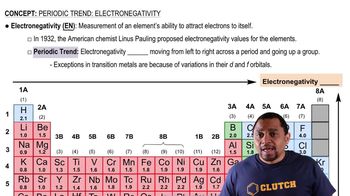
Electronegativity is a measure of an atom's ability to attract and hold onto electrons. In a compound, if the difference in electronegativity between the atoms is significant, it usually indicates ionic bonding. Conversely, similar electronegativities suggest covalent bonding, which is common in molecular compounds.
Video consigliato:
Percorso guidato
02:10
Electronegativity Trends