Complete the table by filling in the formula for the ionic compound formed by each pair of cations and anions, as shown for the first pair. Ion Na+ Ca2+ Fe2+ Al3+ O2- Na2O NO3- SO42- AsO43-
Ch.2 - Atoms, Molecules, and Ions
Brown14th EditionChemistry: The Central ScienceISBN: 9780134414232Non è quello che usi tu?Cambia libro di testo
Capitolo 2, Problema 65b,c,d
Predict whether each of the following compounds is molecular or ionic: (b) CH3OCH3 (c) Mg(NO3)2 (d) H2S
Guida verificata passo dopo passo1
Step 1: Understand the difference between molecular and ionic compounds. Molecular compounds are formed by covalent bonds between nonmetals, while ionic compounds are formed by the electrostatic attraction between cations and anions, typically involving a metal and a nonmetal.
Step 2: Identify the elements present in the compound CH3OCH3. This compound consists of carbon (C), hydrogen (H), and oxygen (O).
Step 3: Determine the types of elements involved. Carbon, hydrogen, and oxygen are all nonmetals.
Step 4: Consider the bonding in the compound. Since all the elements are nonmetals, they are likely to form covalent bonds with each other.
Step 5: Conclude that CH3OCH3 is a molecular compound because it is composed of nonmetals bonded covalently.

Risposta video verificata per un problema simile:
Questa soluzione video è stata consigliata dai nostri tutor come utile per risolvere questo problema.
Durata del video:
2mConcetti chiave
Ecco i concetti essenziali che devi comprendere per rispondere correttamente alla domanda.
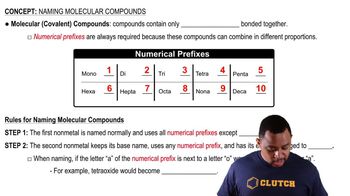
Molecular Compounds
Molecular compounds are formed when two or more nonmetals share electrons through covalent bonds. They typically have low melting and boiling points and can exist in various states (solid, liquid, gas) at room temperature. The presence of specific elements, such as carbon and hydrogen, often indicates a molecular compound.
Video consigliato:
Percorso guidato
Naming Molecular Compounds
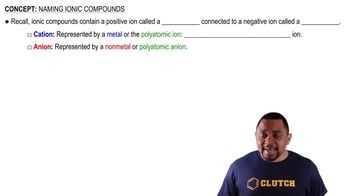
Ionic Compounds
Ionic compounds are formed when metals transfer electrons to nonmetals, resulting in the formation of charged ions that attract each other due to electrostatic forces. These compounds usually have high melting and boiling points and are often soluble in water. The presence of a metal and a nonmetal in a compound typically suggests it is ionic.
Video consigliato:
Percorso guidato
Ionic Compounds Naming
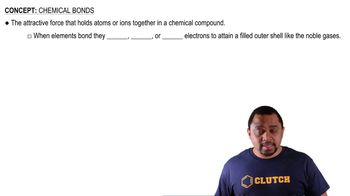
Chemical Structure and Bonding
The chemical structure of a compound determines its classification as molecular or ionic. In the case of CH3OCH3 (dimethyl ether), the structure consists of covalent bonds between carbon, hydrogen, and oxygen atoms, indicating it is a molecular compound. Understanding the arrangement of atoms and the types of bonds formed is crucial for predicting the nature of a compound.
Video consigliato:
Percorso guidato
Chemical Bonds
Pratica correlata
Domanda del libro di testo
426
views
Domanda del libro di testo
Predict whether each of the following compounds is molecular or ionic: (a) HClO4
611
views
Domanda del libro di testo
Predict whether each of the following compounds is molecular or ionic: (f) K2O2 (g) PCl5
532
views
Domanda del libro di testo
Predict whether each of the following compounds is molecular or ionic: (e) TiCl4
389
views
Domanda del libro di testo
Predict whether each of the following compounds is molecular or ionic: (h) P(OH)3.
284
views
Domanda del libro di testo
Complete the table by filling in the formula for the ionic compound formed by each pair of cations and anions, as shown for the first pair. Ion K+ NH4+ Mg2+ Fe3+ Cl- KCl OH- CO32- PO43-
Complete the first row of the table.
Complete the second row of the table.
Complete the third row of the table.
Complete the fourth row of the table.
614
views