
Ch.20 - Electrochemistry
Brown - Chemistry: The Central Science 14th Edition
Brown14th EditionChemistry: The Central ScienceISBN: 9780134414232Non è quello che usi tu?Cambia libro di testo
Capitolo 20, Problema 102b,c

A voltaic cell is constructed that uses the following half-cell reactions:
Cu+(aq) + e- → Cu(s)
I2(s) + 2 e- → 2 I-(aq)
The cell is operated at 298 K with [Cu+] = 0.25 M and [I-] = 0.035 M.
(b) Which electrode is the anode of the cell?
(c) Is the answer to part (b) the same as it would be if the cell were operated under standard conditions?

Guida verificata passo dopo passo
1
Identify the oxidation and reduction half-reactions. In the given cell, Cu+(aq) + e- → Cu(s) is the reduction half-reaction, and I2(s) + 2 e- → 2 I-(aq) is the oxidation half-reaction.
Determine which electrode is the anode. The anode is where oxidation occurs. Since I2 is being reduced to I-, the I2/I- half-cell is the anode.
Consider the standard cell potential (E°) for each half-reaction. Under standard conditions, the half-reaction with the lower (more negative) standard reduction potential is the anode.
Compare the cell operation under non-standard conditions to standard conditions. Under non-standard conditions, the concentrations of the ions can affect the cell potential, but the identity of the anode and cathode is determined by the direction of electron flow.
Conclude whether the anode remains the same under standard conditions. Since the identity of the anode is based on the inherent tendency of the half-reactions to oxidize or reduce, it should remain the same under standard conditions.

Risposta video verificata per un problema simile:

Questa soluzione video è stata consigliata dai nostri tutor come utile per risolvere questo problema.
Durata del video:
6m

Concetti chiave

Ecco i concetti essenziali che devi comprendere per rispondere correttamente alla domanda.

Voltaic Cell and Electrode Reactions

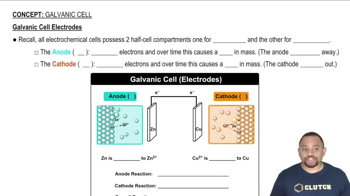
A voltaic cell generates electrical energy through spontaneous redox reactions. In this setup, oxidation occurs at the anode, where electrons are released, while reduction occurs at the cathode, where electrons are accepted. Understanding the half-cell reactions is crucial to identify which species is oxidized and which is reduced, thus determining the anode and cathode.
Video consigliato:
Percorso guidato
06:36
Galvanic Cell Electrodes

Standard Conditions and Nernst Equation

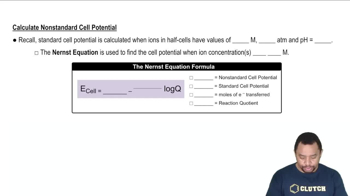
Standard conditions refer to a set of specific conditions (1 M concentration, 1 atm pressure, and 25°C) under which the standard electrode potentials are measured. The Nernst equation relates the cell potential to the concentrations of the reactants and products, allowing for the calculation of cell potential under non-standard conditions. This is essential for comparing the behavior of the cell under varying concentrations.
Video consigliato:
Percorso guidato
01:17
The Nernst Equation

Electrode Designation: Anode vs. Cathode

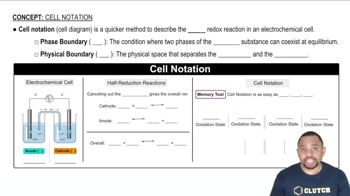
In electrochemistry, the anode is defined as the electrode where oxidation occurs, while the cathode is where reduction takes place. The designation of electrodes can change based on the direction of electron flow and the specific reactions involved. Understanding how to identify these electrodes based on the half-reactions is key to answering questions about the cell's operation and behavior under different conditions.
Video consigliato: