

The capacity of batteries such as the typical AA alkaline battery is expressed in units of milliamp-hours (mAh). An AA alkaline battery yields a nominal capacity of 2850 mAh. (b) The starting voltage of a fresh alkaline battery is 1.55 V. The voltage decreases during discharge and is 0.80 V when the battery has delivered its rated capacity. If we assume that the voltage declines linearly as current is withdrawn, estimate the total maximum electrical work the battery could perform during discharge.
Ch.20 - Electrochemistry
Brown14th EditionChemistry: The Central ScienceISBN: 9780134414232Non è quello che usi tu?Cambia libro di testo
Capitolo 20, Problema 103
Using data from Appendix E, calculate the equilibrium constant for the disproportionation of the copper(I) ion at room temperature: 2 Cu+(aq) ⇌ Cu2+(aq) + Cu(s).
Guida verificata passo dopo passo1
Identify the half-reactions involved in the disproportionation of Cu^+ ions. The two half-reactions are: Cu^+ -> Cu^2+ + e^- and Cu^+ + e^- -> Cu(s).
Look up the standard reduction potentials (E°) for each half-reaction from Appendix E. The standard reduction potential for Cu^2+ + e^- -> Cu^+ is E°1, and for Cu^+ + e^- -> Cu(s) is E°2.
Calculate the standard cell potential (E°cell) for the overall reaction by subtracting the standard reduction potential of the oxidation half-reaction from the reduction half-reaction: E°cell = E°1 - E°2.
Use the Nernst equation to relate the standard cell potential to the equilibrium constant (K). The equation is: E°cell = (RT/nF) * ln(K), where R is the gas constant, T is the temperature in Kelvin, n is the number of moles of electrons transferred, and F is Faraday's constant.
Rearrange the Nernst equation to solve for the equilibrium constant (K): K = exp((nF * E°cell) / (RT)). Substitute the known values to find K.
Concetti chiave
Ecco i concetti essenziali che devi comprendere per rispondere correttamente alla domanda.
Equilibrium Constant (K)
The equilibrium constant (K) is a numerical value that expresses the ratio of the concentrations of products to reactants at equilibrium for a given chemical reaction. It is calculated using the formula K = [products]/[reactants], where the concentrations are raised to the power of their coefficients in the balanced equation. A larger K value indicates a greater extent of reaction towards products, while a smaller K suggests a preference for reactants.
Video consigliato:
Percorso guidato
Equilibrium Constant K
Disproportionation Reaction
A disproportionation reaction is a specific type of redox reaction in which a single substance is simultaneously oxidized and reduced, resulting in two different products. In the case of copper(I) ions, two Cu<sup>+</sup> ions react to form one Cu<sup>2+</sup> ion and solid copper (Cu). Understanding this concept is crucial for analyzing the changes in oxidation states and the stoichiometry of the reaction.
Video consigliato:
Percorso guidato
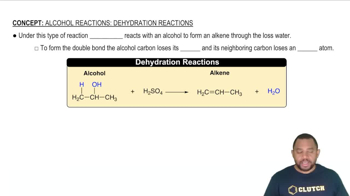
Alcohol Reactions: Dehydration Reactions
Standard Reduction Potentials
Standard reduction potentials (E°) are values that indicate the tendency of a chemical species to gain electrons and be reduced, measured under standard conditions. These potentials are essential for calculating the equilibrium constant using the Nernst equation or the relationship between Gibbs free energy and K. For the copper(I) and copper(II) ions, knowing their standard reduction potentials allows for the determination of the overall cell potential and the direction of the reaction.
Video consigliato:
Percorso guidato
Standard Reduction Potentials
Pratica correlata
Domanda del libro di testo
9696
views
Domanda del libro di testo
A voltaic cell is constructed that uses the following half-cell reactions:
Cu+(aq) + e- → Cu(s)
I2(s) + 2 e- → 2 I-(aq)
The cell is operated at 298 K with [Cu+] = 0.25 M and [I-] = 0.035 M.
(a) Determine E for the cell at these concentrations.
2756
views
1
rank
Domanda del libro di testo
(b) Given
the following reduction potentials, calculate the standard
emf of the cell:
Cd1OH221s2 + 2 e- ¡ Cd1s2 + 2 OH-1aq2
E°red = -0.76 V
NiO1OH21s2 + H2O1l2 + e- ¡ Ni1OH221s2 + OH-1aq2
E°red = +0.49 V
1395
views
Domanda del libro di testo
A voltaic cell is constructed that uses the following half-cell reactions:
Cu+(aq) + e- → Cu(s)
I2(s) + 2 e- → 2 I-(aq)
The cell is operated at 298 K with [Cu+] = 0.25 M and [I-] = 0.035 M.
(b) Which electrode is the anode of the cell?
(c) Is the answer to part (b) the same as it would be if the cell were operated under standard conditions?
3
views
