
Ch.20 - Electrochemistry
Brown - Chemistry: The Central Science 14th Edition
Brown14th EditionChemistry: The Central ScienceISBN: 9780134414232Non è quello che usi tu?Cambia libro di testo
Capitolo 20, Problema 113a,b,d

Aqueous solutions of ammonia (NH3) and bleach (active ingredient NaOCl) are sold as cleaning fluids, but bottles of both of them warn: 'Never mix ammonia and bleach, as toxic gases may be produced.' One of the toxic gases that can be produced is chloroamine, NH2Cl. (a) What is the oxidation number of chlorine in bleach? (active ingredient NaOCl) are sold as cleaning fluids, but bottles of both of them warn: “Never mix ammonia and bleach, as toxic gases may be produced.” One of the toxic gases that can be produced is chloroamine, NH2Cl. (b) What is the oxidation number of chlorine in chloramine? (d) Another toxic gas that can be produced is nitrogen trichloride, NCl3. What is the oxidation number of N in nitrogen trichloride?

Guida verificata passo dopo passo
1
Identify the chemical formula of chloramine, which is NH_2Cl.
Recall that the sum of oxidation numbers in a neutral compound is zero.
Assign oxidation numbers to hydrogen and nitrogen: hydrogen (H) is +1 and nitrogen (N) is typically -3 in compounds.
Set up an equation using the known oxidation numbers: 2(+1) + (-3) + x = 0, where x is the oxidation number of chlorine (Cl).
Solve the equation for x to find the oxidation number of chlorine in chloramine.

Risposta video verificata per un problema simile:

Questa soluzione video è stata consigliata dai nostri tutor come utile per risolvere questo problema.
Durata del video:
1m

Concetti chiave

Ecco i concetti essenziali che devi comprendere per rispondere correttamente alla domanda.

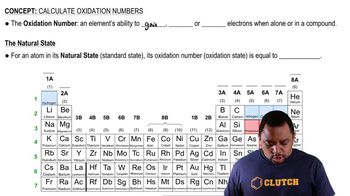
Oxidation Number

The oxidation number, or oxidation state, is a concept used to indicate the degree of oxidation of an atom in a compound. It represents the hypothetical charge an atom would have if all bonds were ionic. Oxidation numbers are assigned based on a set of rules, including the fact that the oxidation number of an element in its elemental form is zero, and for monoatomic ions, it equals the charge of the ion.
Video consigliato:
Percorso guidato
02:42
Oxidation Numbers

Chloroamine Structure

Chloroamine, specifically NH2Cl, is a compound that contains nitrogen, hydrogen, and chlorine. In this molecule, the nitrogen atom is bonded to two hydrogen atoms and one chlorine atom. Understanding the structure of chloroamine is essential for determining the oxidation state of chlorine, as it helps visualize how the atoms are arranged and how they interact with each other.
Video consigliato:
Percorso guidato
01:42
Resonance Structures

Determining Oxidation States

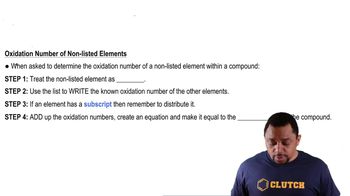
To determine the oxidation state of chlorine in chloroamine, one must consider the known oxidation states of the other atoms in the molecule. Nitrogen typically has an oxidation state of -3 when bonded to hydrogen, and hydrogen has an oxidation state of +1. By applying the rule that the sum of oxidation states in a neutral compound must equal zero, one can calculate the oxidation state of chlorine in NH2Cl.
Video consigliato:
Percorso guidato
01:09
Determining Oxidation Numbers