
Ch.20 - Electrochemistry
Brown - Chemistry: The Central Science 14th Edition
Brown14th EditionChemistry: The Central ScienceISBN: 9780134414232Non è quello che usi tu?Cambia libro di testo
Capitolo 20, Problema 111b

The Haber process is the principal industrial route for converting nitrogen into ammonia: N2(g) + 3 H2(g) → 2 NH3(g) (b) Using the thermodynamic data in Appendix C, calculate the equilibrium constant for the process at room temperature.

Guida verificata passo dopo passo
1
Identify the relevant thermodynamic data needed for the calculation, such as the standard enthalpy change (\( \Delta H^\circ \)) and the standard entropy change (\( \Delta S^\circ \)) for the reaction.
Use the Gibbs free energy equation \( \Delta G^\circ = \Delta H^\circ - T \Delta S^\circ \) to calculate the standard Gibbs free energy change (\( \Delta G^\circ \)) for the reaction at room temperature (298 K).
Convert the calculated \( \Delta G^\circ \) from joules to kilojoules if necessary, to maintain consistency with the units typically used in thermodynamic tables.
Use the relationship between Gibbs free energy and the equilibrium constant \( K \), given by \( \Delta G^\circ = -RT \ln K \), where \( R \) is the universal gas constant (8.314 J/mol·K), to solve for \( K \).
Rearrange the equation to solve for the equilibrium constant \( K \): \( K = e^{-\Delta G^\circ / RT} \), and substitute the values to find \( K \).

Risposta video verificata per un problema simile:

Questa soluzione video è stata consigliata dai nostri tutor come utile per risolvere questo problema.
Durata del video:
7m

Concetti chiave

Ecco i concetti essenziali che devi comprendere per rispondere correttamente alla domanda.

Haber Process

The Haber process is a chemical reaction that synthesizes ammonia from nitrogen and hydrogen gases. It is represented by the equation N₂(g) + 3 H₂(g) → 2 NH₃(g). This process is crucial for producing fertilizers and has significant implications for agriculture and food production.
Video consigliato:
Percorso guidato
03:49
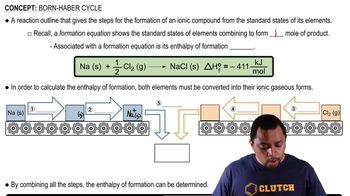
Born Haber Cycle

Equilibrium Constant (K)

The equilibrium constant (K) is a numerical value that expresses the ratio of the concentrations of products to reactants at equilibrium for a given reaction at a specific temperature. It provides insight into the extent of a reaction and whether it favors products or reactants. For the Haber process, K can be calculated using the concentrations of NH₃, N₂, and H₂ at equilibrium.
Video consigliato:
Percorso guidato
01:14
Equilibrium Constant K

Thermodynamic Data

Thermodynamic data includes information such as enthalpy, entropy, and Gibbs free energy, which are essential for calculating the equilibrium constant. These values help predict the direction of a reaction and its spontaneity. In the context of the Haber process, thermodynamic data allows for the determination of K at room temperature, facilitating the understanding of the reaction's behavior under standard conditions.
Video consigliato:
Percorso guidato
01:18
First Law of Thermodynamics