Ch.23 - Transition Metals and Coordination Chemistry
Brown - Chemistry: The Central Science 14th Edition
Brown14th EditionChemistry: The Central ScienceISBN: 9780134414232Non è quello che usi tu?Cambia libro di testo
Capitolo 23, Problema 57

Complete the exercises below. Give the number of (valence) d electrons associated with the central metal ion in each of the following complexes: a. K₃ [TiCl₆], b. Na₃ [Co(NO₂)₆], c. [Ru(en)₃] Br₃, d. [Mo(EDTA)] ClO₄, e. K₃ [ReCl₆].

Guida verificata passo dopo passo
1
Step 1: Identify the oxidation state of the central metal ion in each complex. This can be done by considering the charges of the ligands and the overall charge of the complex.
Step 2: Determine the electron configuration of the neutral metal atom, focusing on the d electrons. This involves knowing the position of the element in the periodic table.
Step 3: Calculate the number of d electrons in the metal ion by subtracting the oxidation state from the total number of d electrons in the neutral atom.
Step 4: For each complex, consider the ligands and their charges to ensure the oxidation state of the metal ion is correctly determined.
Step 5: Verify the number of d electrons by checking the consistency of the oxidation state and the electron configuration with known chemical properties of the metal.

Concetti chiave

Ecco i concetti essenziali che devi comprendere per rispondere correttamente alla domanda.

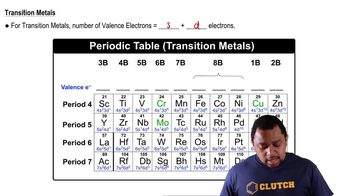
Valence Electrons

Valence electrons are the outermost electrons of an atom and are crucial for determining how an element interacts chemically. In transition metals, these include the s and d electrons in the highest energy levels. Understanding the number of valence electrons helps predict the oxidation states and coordination behavior of metal ions in complexes.
Video consigliato:
Percorso guidato
02:12
Transition Metals Valence Electrons

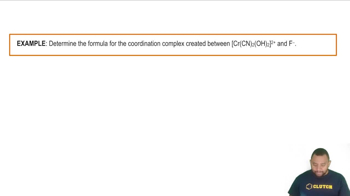
Coordination Complexes

Coordination complexes consist of a central metal atom or ion bonded to surrounding molecules or ions, known as ligands. The nature of these ligands and their arrangement around the metal ion can significantly influence the properties of the complex, including its stability and reactivity. Identifying the ligands is essential for determining the electron count associated with the central metal.
Video consigliato:
Percorso guidato
00:43
Coordination Complexes Example

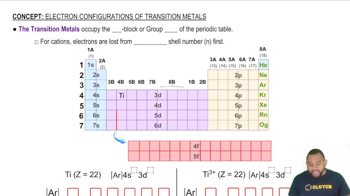
Oxidation States of Transition Metals

Transition metals can exhibit multiple oxidation states due to the involvement of d electrons in bonding. The oxidation state of the metal in a complex can be determined by considering the charges of the ligands and the overall charge of the complex. This is vital for calculating the number of d electrons, as the d electron count is influenced by the oxidation state of the metal ion.
Video consigliato:
Percorso guidato
03:12
Transition Metals