Ch.4 - Reactions in Aqueous Solution
Brown - Chemistry: The Central Science 14th Edition
Brown14th EditionChemistry: The Central ScienceISBN: 9780134414232Non è quello che usi tu?Cambia libro di testo
Capitolo 4, Problema 49c

Determine the oxidation number for the indicated element in each of the following substances: (c) P in AgPF6

Guida verificata passo dopo passo
1
Identify the oxidation states of the known elements in the compound. In AgPF6, silver (Ag) typically has an oxidation state of +1, and fluorine (F) always has an oxidation state of -1.
Write the formula for the compound and assign the known oxidation states. For AgPF6, it would be Ag(+1) P(x) F6(-1 each).
Set up an equation based on the rule that the sum of the oxidation states in a neutral compound must equal zero. The equation will be: 1 + x + 6(-1) = 0.
Solve for x, which represents the oxidation state of phosphorus (P) in the compound. Rearrange the equation to isolate x.
Verify the calculated oxidation state of phosphorus by checking if the sum of all oxidation states in the compound equals zero.

Risposta video verificata per un problema simile:

Questa soluzione video è stata consigliata dai nostri tutor come utile per risolvere questo problema.
Durata del video:
2m

Concetti chiave

Ecco i concetti essenziali che devi comprendere per rispondere correttamente alla domanda.

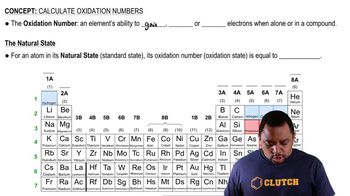
Oxidation Number

The oxidation number, or oxidation state, is a theoretical charge assigned to an atom in a compound, reflecting its degree of oxidation or reduction. It helps in understanding electron transfer in redox reactions and is determined based on a set of rules, such as the oxidation state of elements in their elemental form being zero and the sum of oxidation states in a neutral compound being zero.
Video consigliato:
Percorso guidato
02:42
Oxidation Numbers

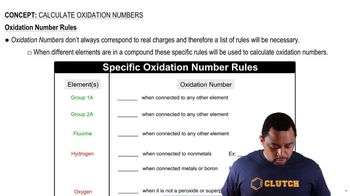
Rules for Assigning Oxidation Numbers

There are specific rules for assigning oxidation numbers, including that alkali metals are always +1, alkaline earth metals are +2, and fluorine is always -1. Oxygen typically has an oxidation number of -2, while hydrogen is usually +1. In polyatomic ions, the sum of the oxidation numbers must equal the charge of the ion, which is crucial for determining the oxidation state of elements in compounds.
Video consigliato:
Percorso guidato
03:13
Oxidation Number Rules

Complex Ions and Coordination Compounds

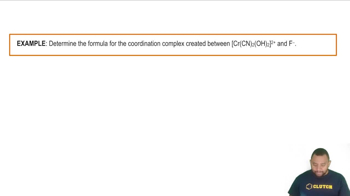
In coordination compounds like AgPF6, the central metal atom (Ag) is surrounded by ligands (PF6). The oxidation state of the central atom can be influenced by the charges of the ligands. Understanding how to analyze these compounds is essential for determining the oxidation state of the elements involved, as it requires knowledge of both the ligands' charges and the overall charge of the complex.
Video consigliato:
Percorso guidato
00:43
Coordination Complexes Example