Determine the oxidation number for the indicated element in each of the following substances: (c) P in AgPF6
Ch.4 - Reactions in Aqueous Solution
Brown14th EditionChemistry: The Central ScienceISBN: 9780134414232Non è quello che usi tu?Cambia libro di testo
Capitolo 4, Problema 49a,b
Determine the oxidation number for the indicated element in each of the following substances: (a) S in SO3 (b) Ti in TiCl4
Guida verificata passo dopo passo1
Identify the oxidation number of oxygen, which is typically -2.
Let the oxidation number of sulfur (S) be x.
Write the chemical formula for sulfur trioxide: SO_3.
Set up the equation based on the sum of oxidation numbers in a neutral compound: x + 3(-2) = 0.
Solve for x to find the oxidation number of sulfur.

Risposta video verificata per un problema simile:
Questa soluzione video è stata consigliata dai nostri tutor come utile per risolvere questo problema.
Durata del video:
2mConcetti chiave
Ecco i concetti essenziali che devi comprendere per rispondere correttamente alla domanda.
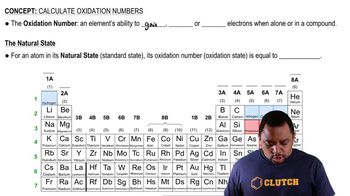
Oxidation Number
The oxidation number, or oxidation state, is a theoretical charge assigned to an atom in a compound based on the assumption that electrons are completely transferred. It helps in understanding the electron distribution in molecules and is crucial for identifying redox reactions. Oxidation numbers can be positive, negative, or zero, depending on the atom's electron gain or loss.
Video consigliato:
Percorso guidato
Oxidation Numbers
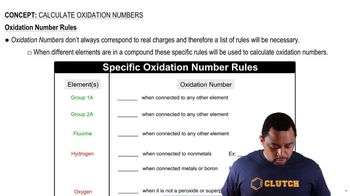
Rules for Assigning Oxidation Numbers
There are specific rules for assigning oxidation numbers, such as the fact that the oxidation number of an element in its elemental form is zero, and for monoatomic ions, it equals the charge of the ion. In compounds, hydrogen typically has an oxidation number of +1, oxygen usually has -2, and the sum of oxidation numbers in a neutral compound must equal zero. These rules guide the determination of oxidation states in various substances.
Video consigliato:
Percorso guidato
Oxidation Number Rules
Sulfur in SO3
In sulfur trioxide (SO3), sulfur is the central atom surrounded by three oxygen atoms. To find the oxidation number of sulfur, we apply the rules for oxidation states. Given that each oxygen has an oxidation number of -2, the total contribution from oxygen is -6. To balance this in a neutral molecule, sulfur must have an oxidation number of +6, indicating it has lost six electrons in this compound.
Video consigliato:
Percorso guidato
Hess's Law and Equilibrium Constant
Pratica correlata
Domanda del libro di testo
758
views
Domanda del libro di testo
Determine the oxidation number for the indicated element in each of the following substances: (e) Pt in PtCl4 (f) O in OF2.
519
views
Domanda del libro di testo
Determine the oxidation number for the indicated element in each of the following substances: (d) N in HNO3
399
views
Domanda del libro di testo
Determine the oxidation number of sulfur in each of the following substances: (f) Which region(s) of the periodic table contains elements that can adopt both positive and negative oxidation numbers?
710
views
Domanda del libro di testo
Determine the oxidation number of sulfur in each of the following substances: (d) hydrogen sulfide, H2S
524
views
Domanda del libro di testo
Determine the oxidation number of sulfur in each of the following substances: (e) Locate sulfur in the periodic table in Exercise 4.47; what region is it in?
499
views