Ch.4 - Reactions in Aqueous Solution
Brown - Chemistry: The Central Science 14th Edition
Brown14th EditionChemistry: The Central ScienceISBN: 9780134414232Non è quello che usi tu?Cambia libro di testo
Capitolo 4, Problema 50e,f

Determine the oxidation number for the indicated element in each of the following substances: (e) Pt in PtCl4 (f) O in OF2.

Guida verificata passo dopo passo
1
Identify the oxidation number of Cl, which is typically -1.
Let the oxidation number of Pt be x.
Write the equation for the sum of oxidation numbers in the compound: x + 4(-1) = 0.
Simplify the equation: x - 4 = 0.
Solve for x to find the oxidation number of Pt.

Risposta video verificata per un problema simile:

Questa soluzione video è stata consigliata dai nostri tutor come utile per risolvere questo problema.
Durata del video:
2m

Concetti chiave

Ecco i concetti essenziali che devi comprendere per rispondere correttamente alla domanda.

Oxidation Number

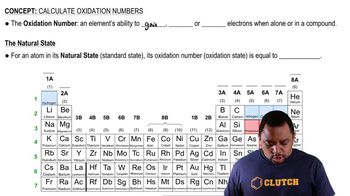
The oxidation number, or oxidation state, is a value assigned to an element in a compound that reflects its degree of oxidation or reduction. It indicates the number of electrons an atom gains, loses, or shares when forming chemical bonds. Oxidation numbers are crucial for understanding redox reactions and determining the electron flow in chemical processes.
Video consigliato:
Percorso guidato
02:42
Oxidation Numbers

Rules for Assigning Oxidation Numbers

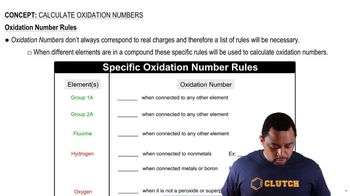
There are specific rules for assigning oxidation numbers, such as the fact that the oxidation number of an element in its elemental form is zero, and for monoatomic ions, it equals the charge of the ion. In compounds, more electronegative elements typically have negative oxidation numbers, while less electronegative elements have positive values. These rules help in systematically determining the oxidation states of elements in various compounds.
Video consigliato:
Percorso guidato
03:13
Oxidation Number Rules

Coordination Compounds

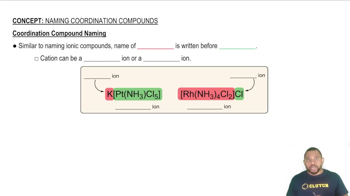
Coordination compounds consist of a central metal atom or ion bonded to surrounding molecules or ions, known as ligands. In the case of PtCl4, platinum (Pt) is the central metal, and the four chloride ions (Cl) act as ligands. Understanding the structure and bonding in coordination compounds is essential for determining the oxidation state of the central metal, as it influences the overall charge of the complex.
Video consigliato:
Percorso guidato
01:32
Coordination Compound Naming