
Ch.5 - Thermochemistry
Brown - Chemistry: The Central Science 14th Edition
Brown14th EditionChemistry: The Central ScienceISBN: 9780134414232Non è quello che usi tu?Cambia libro di testo
Capitolo 5, Problema 42a

Without referring to tables, predict which of the following has the higher enthalpy in each case: (a) 1 mol I2(s) or 1 mol I2(g) at the same temperature

Guida verificata passo dopo passo
1
Understand the concept of enthalpy: Enthalpy (H) is a measure of the total energy of a thermodynamic system, including internal energy and the energy required to make room for it by displacing its environment.
Recognize the states of matter: In this problem, we are comparing iodine in solid state (I2(s)) and iodine in gaseous state (I2(g)).
Consider the energy required for phase changes: Transitioning from a solid to a gas requires energy to overcome intermolecular forces. This process is known as sublimation.
Relate enthalpy to phase changes: The enthalpy of the gaseous state is generally higher than that of the solid state for the same substance at the same temperature because additional energy is stored in the system as potential energy, overcoming the attractive forces between particles.
Predict the higher enthalpy: Given that sublimation requires energy input, 1 mol of I2(g) would have a higher enthalpy than 1 mol of I2(s) at the same temperature.

Risposta video verificata per un problema simile:

Questa soluzione video è stata consigliata dai nostri tutor come utile per risolvere questo problema.
Durata del video:
1m

Concetti chiave

Ecco i concetti essenziali che devi comprendere per rispondere correttamente alla domanda.

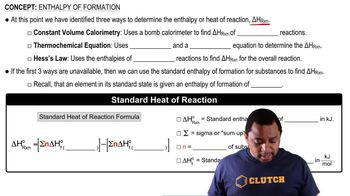
Enthalpy

Enthalpy is a thermodynamic property that represents the total heat content of a system. It is defined as the sum of the internal energy and the product of pressure and volume. Enthalpy changes are crucial for understanding heat transfer during chemical reactions and phase changes, making it essential for predicting the stability and energy of substances in different states.
Video consigliato:
Percorso guidato
02:34
Enthalpy of Formation

Phase Changes

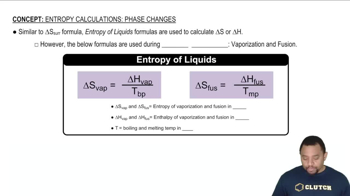
Phase changes refer to the transitions between solid, liquid, and gas states of matter. These changes involve energy transfer, typically in the form of heat, which affects the enthalpy of a substance. For example, when a solid transitions to a gas (sublimation), it absorbs energy, resulting in a higher enthalpy for the gaseous state compared to the solid state.
Video consigliato:
Percorso guidato
01:46
Entropy in Phase Changes

Gibbs Free Energy

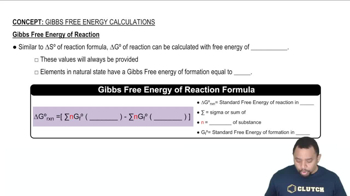
Gibbs Free Energy (G) is a thermodynamic potential that measures the maximum reversible work obtainable from a thermodynamic system at constant temperature and pressure. It combines enthalpy and entropy to predict the spontaneity of processes. While not directly asked in the question, understanding Gibbs Free Energy helps contextualize why certain phases are favored under specific conditions, such as temperature.
Video consigliato:
Percorso guidato
01:51
Gibbs Free Energy of Reactions