
Domanda del libro di testo
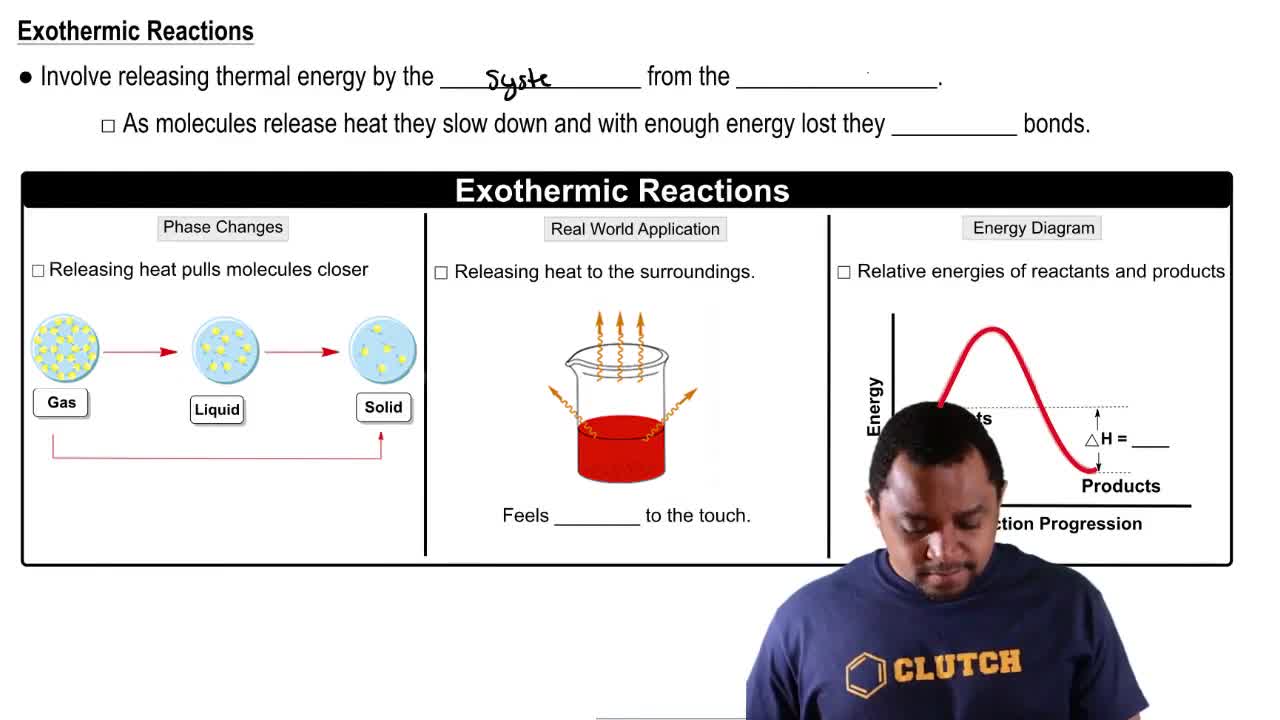
Without referring to tables, predict which of the following has the higher enthalpy in each case: (a) 1 mol I2(s) or 1 mol I2(g) at the same temperature
766
views

 Guida verificata passo dopo passo
 02:34
02:34
 02:38
02:38 01:22
01:22Without referring to tables, predict which of the following has the higher enthalpy in each case: (a) 1 mol I2(s) or 1 mol I2(g) at the same temperature
The decomposition of sodium bicarbonate (baking soda), NaHCO3(s), into Na2CO3(s), H2O(l), and CO2(g) at constant pressure requires the addition of 85 kJ of heat per two moles of NaHCO3. (a) Write a balanced thermochemical equation for the reaction.
Without referring to tables, predict which of the following has the higher enthalpy in each case: (b) 2 mol of iodine atoms or 1 mol of I2
Without referring to tables, predict which of the following has the higher enthalpy in each case: (c) 1 mol I2(g) and 1 mol H2(g) at 25 °C or 2 mol HI(g) at 25 °C (d) 1 mol H2(g) at 100 °C or 1 mol H2(g) at 300 °C.
The complete combustion of methane, CH4(g), to form H2O(l) and CO2(g) at constant pressure releases 890 kJ of heat per mole of CH4. (b) Draw an enthalpy diagram for the reaction.
Atomic hydrogen (H) is used in welding (AHW). The atoms recombine to hydrogen molecules with a large release of heat according to the following reaction: 2 H(g) → H2(g) (a) Using the thermodynamic data in Appendix C, calculate the enthalpy change for this reaction per mole of H2.