
Ch.5 - Thermochemistry
Brown - Chemistry: The Central Science 14th Edition
Brown14th EditionChemistry: The Central ScienceISBN: 9780134414232Non è quello che usi tu?Cambia libro di testo
Capitolo 5, Problema 62a

Consider the following hypothetical reactions: A → B ΔHI = +60 kJ B → C ΔHII = -90 kJ (a) Use Hess’s law to calculate the enthalpy change for the reaction A → C.

Guida verificata passo dopo passo
1
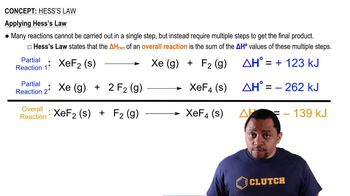
Understand Hess's Law: It states that the total enthalpy change for a reaction is the same, no matter how many steps the reaction is carried out in. This means we can add the enthalpy changes of individual steps to find the overall enthalpy change.
Identify the given reactions and their enthalpy changes: The first reaction is A → B with ΔH = +60 kJ, and the second reaction is B → C with ΔH = -90 kJ.
Write the target reaction: We need to find the enthalpy change for the reaction A → C.
Apply Hess's Law: Add the enthalpy changes of the given reactions to find the enthalpy change for the target reaction. This involves summing the enthalpy changes: ΔH (A → C) = ΔH (A → B) + ΔH (B → C).
Substitute the given values into the equation: ΔH (A → C) = +60 kJ + (-90 kJ). Calculate the sum to find the overall enthalpy change for the reaction A → C.

Risposta video verificata per un problema simile:

Questa soluzione video è stata consigliata dai nostri tutor come utile per risolvere questo problema.
Durata del video:
2m

Concetti chiave

Ecco i concetti essenziali che devi comprendere per rispondere correttamente alla domanda.

Hess's Law

Hess's Law states that the total enthalpy change for a chemical reaction is the sum of the enthalpy changes for the individual steps of the reaction, regardless of the pathway taken. This principle allows us to calculate the enthalpy change for a reaction by combining the enthalpy changes of related reactions, making it a powerful tool in thermochemistry.
Video consigliato:

Enthalpy Change (ΔH)

Enthalpy change (ΔH) is a measure of the heat content of a system at constant pressure. It indicates whether a reaction is exothermic (releases heat, ΔH < 0) or endothermic (absorbs heat, ΔH > 0). Understanding the sign and magnitude of ΔH is crucial for predicting the energy changes associated with chemical reactions.
Video consigliato:
Percorso guidato
02:34
Enthalpy of Formation

Thermochemical Equations

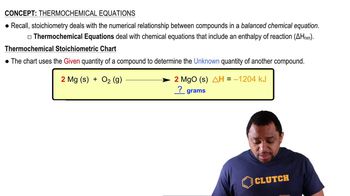
Thermochemical equations represent chemical reactions along with their associated enthalpy changes. These equations provide essential information about the energy changes that occur during reactions, allowing chemists to analyze and predict the heat exchange involved in various processes. Properly balancing these equations is vital for accurate calculations using Hess's Law.
Video consigliato:
Percorso guidato
01:13
Thermochemical Equations
Pratica correlata
Domanda del libro di testo

Under constant-volume conditions, the heat of combustion of benzoic acid (C6H5O6) is 15.57 kJ/g. A 3.500-g sample of sucrose is burned in a bomb calorimeter. The temperature of the calorimeter increases from 20.94 to 24.72 °C. (b) If the size of the sucrose sample had been exactly twice as large, what would the temperature change of the calorimeter have been?

1040
views
Domanda del libro di testo

Under constant-volume conditions, the heat of combustion of naphthalene (C10H8) is 40.18 kJ/g. A 2.50-g sample of naphthalene is burned in a bomb calorimeter. The temperature of the calorimeter increases from 21.50 to 28.83 °C. (c) Suppose that in changing samples, a portion of the water in the calorimeter were lost. In what way, if any, would this change the heat capacity of the calorimeter?

1165
views
Domanda del libro di testo

Consider the following hypothetical reactions: A → B ΔHI = +60 kJ B → C ΔHII = -90 kJ (b) Construct an enthalpy diagram for substances A, B, and C, and show how Hess's law applies.

1311
views
Domanda del libro di testo

Calculate the enthalpy change for the reaction P4O6(s) + 2 O2(g) → P4O10(s) given the following enthalpies of reaction: P4(s) + 3 O2(g) → P4O6(s) ΔH = -1640.1 kJ P4(s) + 5 O2(g) → P4O10(s) ΔH = -2940.1 kJ

1298
views
Domanda del libro di testo

From the enthalpies of reaction 2 C(s) + O2(g) → 2 CO(g) ΔH = -221.0 kJ 2 C(s) + O2(g) + 4 H2(g) → 2 CH3OH(g) ΔH = -402.4 kJ Calculate ΔH for the reaction CO(g) + 2 H2(g) → CH3OH(g)

411
views