
Ch.5 - Thermochemistry
Brown - Chemistry: The Central Science 14th Edition
Brown14th EditionChemistry: The Central ScienceISBN: 9780134414232Non è quello che usi tu?Cambia libro di testo
Capitolo 5, Problema 60c

Under constant-volume conditions, the heat of combustion of naphthalene (C10H8) is 40.18 kJ/g. A 2.50-g sample of naphthalene is burned in a bomb calorimeter. The temperature of the calorimeter increases from 21.50 to 28.83 °C. (c) Suppose that in changing samples, a portion of the water in the calorimeter were lost. In what way, if any, would this change the heat capacity of the calorimeter?

Guida verificata passo dopo passo
1
insert step 1> Understand that the heat capacity of a calorimeter is the amount of heat required to change its temperature by one degree Celsius.
insert step 2> Recognize that the heat capacity is dependent on the mass of the substances within the calorimeter, including water.
insert step 3> Consider that if water is lost from the calorimeter, the total mass of the calorimeter system decreases.
insert step 4> Realize that with less water, the calorimeter would require less heat to achieve the same temperature change, effectively decreasing its heat capacity.
insert step 5> Conclude that losing water from the calorimeter would decrease its overall heat capacity, meaning it would heat up more for the same amount of heat absorbed.

Risposta video verificata per un problema simile:

Questa soluzione video è stata consigliata dai nostri tutor come utile per risolvere questo problema.
Durata del video:
3m

Concetti chiave

Ecco i concetti essenziali che devi comprendere per rispondere correttamente alla domanda.

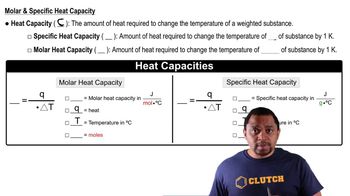
Heat Capacity

Heat capacity is the amount of heat required to change the temperature of a substance by one degree Celsius. In calorimetry, it is crucial for determining how much heat is absorbed or released during a chemical reaction. The heat capacity of a calorimeter is influenced by its mass and the specific heat of the materials it contains, which in this case includes water.
Video consigliato:

Bomb Calorimeter

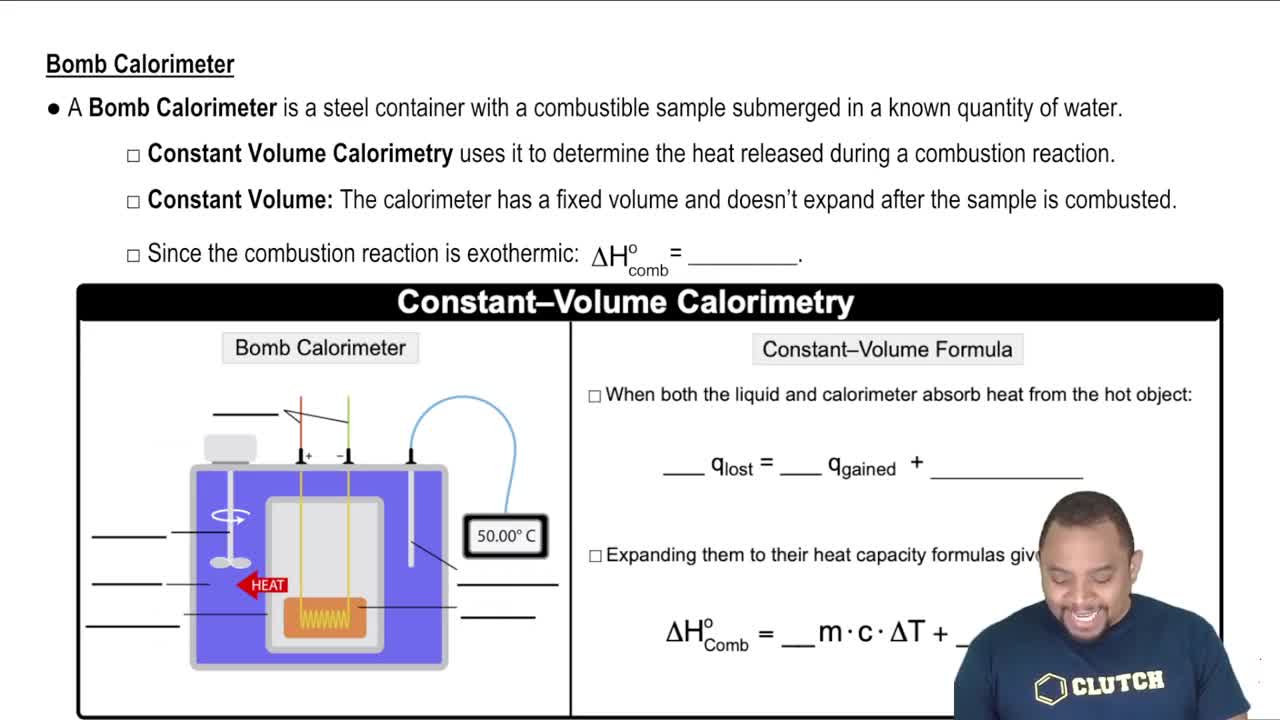
A bomb calorimeter is a device used to measure the heat of combustion of a substance under constant volume conditions. It consists of a sealed container (the bomb) where the reaction occurs, surrounded by a known quantity of water. The temperature change of the water is used to calculate the heat released during the combustion, which is essential for understanding the energy content of fuels.
Video consigliato:
Percorso guidato
02:35
Constant-Volume Calorimetry

Effect of Water Loss on Heat Capacity

If water is lost from the calorimeter, the total heat capacity of the system decreases because the remaining water can absorb less heat. This change affects the temperature change observed during the combustion reaction, as a smaller heat capacity would lead to a larger temperature increase for the same amount of heat released, potentially skewing the results of the experiment.
Video consigliato: