Ch.6 - Electronic Structure of Atoms
Brown - Chemistry: The Central Science 14th Edition
Brown14th EditionChemistry: The Central ScienceISBN: 9780134414232Non è quello che usi tu?Cambia libro di testo
Capitolo 6, Problema 71

What is the maximum number of electrons that can occupy each of the following subshells? (a) 3s, (b) 2p, (c) 4d, (d) 5s.

Guida verificata passo dopo passo
1
First, let's understand the concept of subshells. In an atom, electrons are arranged in energy levels, also known as shells. Each shell is divided into subshells, which are designated as s, p, d, and f. The number before the letter represents the energy level or shell number, and the letter represents the type of subshell.
The maximum number of electrons that can occupy a subshell is determined by the type of subshell. The s subshell can hold a maximum of 2 electrons, the p subshell can hold a maximum of 6 electrons, the d subshell can hold a maximum of 10 electrons, and the f subshell can hold a maximum of 14 electrons.
For subshell (a) 3s, since it's an s subshell, it can hold a maximum of 2 electrons.
For subshell (b) 2p, since it's a p subshell, it can hold a maximum of 6 electrons.
For subshell (c) 4d, since it's a d subshell, it can hold a maximum of 10 electrons.
For subshell (d) 5s, since it's an s subshell, it can hold a maximum of 2 electrons.

Risposta video verificata per un problema simile:

Questa soluzione video è stata consigliata dai nostri tutor come utile per risolvere questo problema.
Durata del video:
6m

Concetti chiave

Ecco i concetti essenziali che devi comprendere per rispondere correttamente alla domanda.

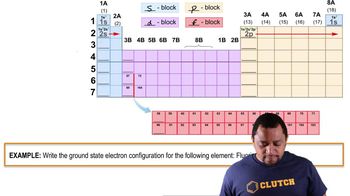
Electron Configuration

Electron configuration describes the distribution of electrons in an atom's orbitals. Each electron occupies a specific subshell based on energy levels and follows the Pauli exclusion principle, which states that no two electrons can have the same set of quantum numbers. Understanding electron configuration is essential for determining how many electrons can fit into each subshell.
Video consigliato:
Percorso guidato
01:33
Electron Configuration Example

Subshells and Their Capacities

Subshells are divisions of electron shells and are designated as s, p, d, and f. Each subshell has a specific maximum number of electrons it can hold: s subshells can hold 2 electrons, p subshells can hold 6, d subshells can hold 10, and f subshells can hold 14. This capacity is derived from the formula 2n², where n is the principal quantum number.
Video consigliato:

Quantum Numbers

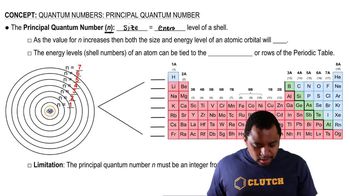
Quantum numbers are sets of numerical values that describe the unique quantum state of an electron in an atom. The principal quantum number (n) indicates the energy level, while the azimuthal quantum number (l) defines the subshell type (s, p, d, f). Understanding quantum numbers is crucial for determining the arrangement of electrons and their respective subshells.
Video consigliato:
Percorso guidato
02:55
Principal Quantum Number
Pratica correlata