Ch.6 - Electronic Structure of Atoms
Brown - Chemistry: The Central Science 14th Edition
Brown14th EditionChemistry: The Central ScienceISBN: 9780134414232Non è quello che usi tu?Cambia libro di testo
Capitolo 6, Problema 72

What is the maximum number of electrons in an atom that can have the following quantum numbers? (a) n = 3, ml = -1; (b) n = 4, l = 2; (c) n = 4, l = 3, ml = -2; (d) n = 5, l = 2, ml = 0.

Guida verificata passo dopo passo
1
1. The quantum numbers describe the properties of atomic orbitals and the electrons in those orbitals. They are: the principal quantum number (n), the azimuthal quantum number (l), the magnetic quantum number (ml), and the spin quantum number (ms).
2. (a) For n = 3, ml = -1, the maximum number of electrons is 2. This is because for any given set of n, l, and ml values, there can be two electrons, one with a spin of +1/2 and one with a spin of -1/2.
3. (b) For n = 4, l = 2, the maximum number of electrons is 10. This is because the magnetic quantum number ml can have values from -l to +l, so for l = 2, ml can be -2, -1, 0, 1, or 2. Each of these 5 ml values can have two electrons (one with spin up and one with spin down), so the total is 5*2 = 10 electrons.
4. (c) For n = 4, l = 3, ml = -2, the maximum number of electrons is 2. Similar to part (a), for any given set of n, l, and ml values, there can be two electrons, one with a spin of +1/2 and one with a spin of -1/2.
5. (d) For n = 5, l = 2, ml = 0, the maximum number of electrons is 2. Again, for any given set of n, l, and ml values, there can be two electrons, one with a spin of +1/2 and one with a spin of -1/2.

Risposta video verificata per un problema simile:

Questa soluzione video è stata consigliata dai nostri tutor come utile per risolvere questo problema.
Durata del video:
3m

Concetti chiave

Ecco i concetti essenziali che devi comprendere per rispondere correttamente alla domanda.

Quantum Numbers

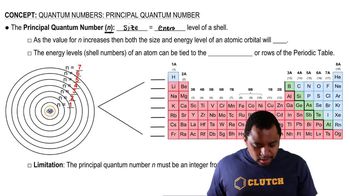
Quantum numbers are a set of numerical values that describe the unique quantum state of an electron in an atom. They include the principal quantum number (n), which indicates the energy level; the azimuthal quantum number (l), which defines the shape of the orbital; the magnetic quantum number (ml), which specifies the orientation of the orbital; and the spin quantum number (ms), which describes the electron's spin direction.
Video consigliato:
Percorso guidato
02:55
Principal Quantum Number

Electron Capacity of Orbitals

Each type of orbital can hold a specific maximum number of electrons. The s, p, d, and f orbitals can hold 2, 6, 10, and 14 electrons, respectively. The maximum number of electrons in a given energy level (n) can be calculated using the formula 2n², which helps determine how many electrons can occupy the orbitals defined by the quantum numbers.
Video consigliato:
Percorso guidato
01:16
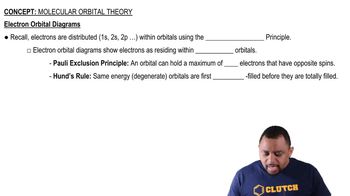
Electron Orbital Diagrams

Allowed Combinations of Quantum Numbers

Not all combinations of quantum numbers are permissible due to specific rules. For instance, the azimuthal quantum number (l) must be less than the principal quantum number (n), and the magnetic quantum number (ml) must range from -l to +l. Understanding these restrictions is crucial for determining the maximum number of electrons that can exist in a given state defined by the quantum numbers.
Video consigliato:
Percorso guidato
02:55
Principal Quantum Number