
Ch.6 - Electronic Structure of Atoms
Brown - Chemistry: The Central Science 14th Edition
Brown14th EditionChemistry: The Central ScienceISBN: 9780134414232Non è quello che usi tu?Cambia libro di testo
Capitolo 6, Problema 70a

An experiment called the Stern–Gerlach experiment helped establish the existence of electron spin. In this experiment, a beam of silver atoms is passed through a magnetic field, which deflects half of the silver atoms in one direction and half in the opposite direction. The separation between the two beams increases as the strength of the magnetic field increases. (a) What is the electron configuration for a silver atom?

Guida verificata passo dopo passo
1
Identify the atomic number of silver (Ag), which is 47.
Determine the electron configuration by filling the orbitals in order of increasing energy, following the Aufbau principle.
Start with the 1s orbital and continue filling the orbitals: 1s^2, 2s^2, 2p^6, 3s^2, 3p^6, 4s^2, 3d^10, 4p^6, 5s^2, 4d^10.
Note that the 5s orbital is filled before the 4d orbital, but the 4d orbital is filled completely before moving to the 5p orbital.
The electron configuration for a silver atom is [Kr] 4d^{10} 5s^1, where [Kr] represents the electron configuration of krypton, the noble gas preceding silver.

Risposta video verificata per un problema simile:

Questa soluzione video è stata consigliata dai nostri tutor come utile per risolvere questo problema.
Durata del video:
3m

Concetti chiave

Ecco i concetti essenziali che devi comprendere per rispondere correttamente alla domanda.

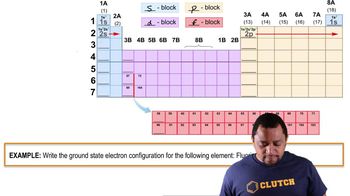
Electron Configuration

Electron configuration describes the distribution of electrons in an atom's orbitals. For silver (Ag), which has an atomic number of 47, the electron configuration is [Kr] 4d^10 5s^1. This notation indicates that silver has a complete set of electrons in the krypton core, ten electrons in the 4d subshell, and one electron in the 5s subshell.
Video consigliato:
Percorso guidato
01:33
Electron Configuration Example

Stern–Gerlach Experiment

The Stern–Gerlach experiment demonstrated the quantization of angular momentum, specifically electron spin. When a beam of silver atoms is passed through a non-uniform magnetic field, the atoms split into two distinct paths, indicating that the spin of the unpaired electron in silver can take on one of two values, often referred to as 'spin-up' and 'spin-down'.
Video consigliato:
Percorso guidato
02:37
Rutherford Experiment Example

Magnetic Fields and Electron Spin

Magnetic fields interact with the magnetic moments of electrons, which arise from their spin and orbital motion. In the context of the Stern–Gerlach experiment, the strength of the magnetic field influences the degree of deflection of the silver atoms, illustrating how electron spin contributes to the magnetic properties of atoms and their behavior in external fields.
Video consigliato:
Percorso guidato
01:28
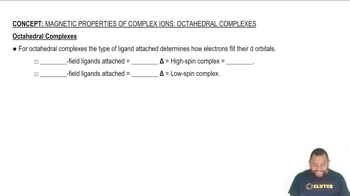
For octahedral complexes, Weak-Field Ligands create High-spin complexes and Strong-Field Ligands create Low-spin complexes.
Pratica correlata