

Ch.7 - Periodic Properties of the Elements
Brown - Chemistry: The Central Science 14th Edition
Brown14th EditionChemistry: The Central ScienceISBN: 9780134414232Non è quello che usi tu?Cambia libro di testo
Capitolo 7, Problema 89c

(c) Will the lithium cobalt oxide cathode expand or contract as lithium ions are inserted?

Guida verificata passo dopo passo
1
Understand the structure of lithium cobalt oxide (LiCoO2), which is a layered oxide where lithium ions are intercalated between layers of cobalt oxide.
Recognize that during the insertion of lithium ions (also known as intercalation), the lithium ions move into the empty spaces within the cobalt oxide layers.
Consider the effect of lithium ion insertion on the lattice structure. The insertion of lithium ions generally leads to an expansion of the lattice along the c-axis (perpendicular to the layers) due to electrostatic repulsion and increased Van der Waals forces.
Analyze how the expansion along one axis might affect the overall volume of the cathode material. Typically, the volume change is an expansion due to the increased spacing between layers.
Conclude that the lithium cobalt oxide cathode will likely expand as lithium ions are inserted, primarily due to the increase in lattice dimensions to accommodate the additional lithium ions.

Risposta video verificata per un problema simile:

Questa soluzione video è stata consigliata dai nostri tutor come utile per risolvere questo problema.
Durata del video:
2m

Concetti chiave

Ecco i concetti essenziali che devi comprendere per rispondere correttamente alla domanda.

Lithium Ion Insertion

Lithium ion insertion refers to the process where lithium ions move into the structure of a cathode material, such as lithium cobalt oxide (LiCoO2), during charging. This process is crucial for the operation of lithium-ion batteries, as it allows for the storage of electrical energy. The movement of these ions can lead to changes in the material's structure and volume.
Video consigliato:

Structural Changes in Cathodes

The insertion of lithium ions into a cathode material can cause structural changes, which may result in either expansion or contraction of the material. In the case of lithium cobalt oxide, the insertion of lithium ions typically leads to an expansion of the lattice structure, as the ions occupy interstitial sites within the crystal framework, increasing the overall volume of the cathode.
Video consigliato:
Percorso guidato
01:53
Chemical Changes

Volume Change and Battery Performance

The volume change of cathode materials during lithium ion insertion is significant for battery performance. If the material expands too much, it can lead to mechanical stress, cracking, or degradation of the electrode, ultimately affecting the battery's lifespan and efficiency. Understanding these volume changes is essential for designing stable and durable battery systems.
Video consigliato:
Percorso guidato
02:35
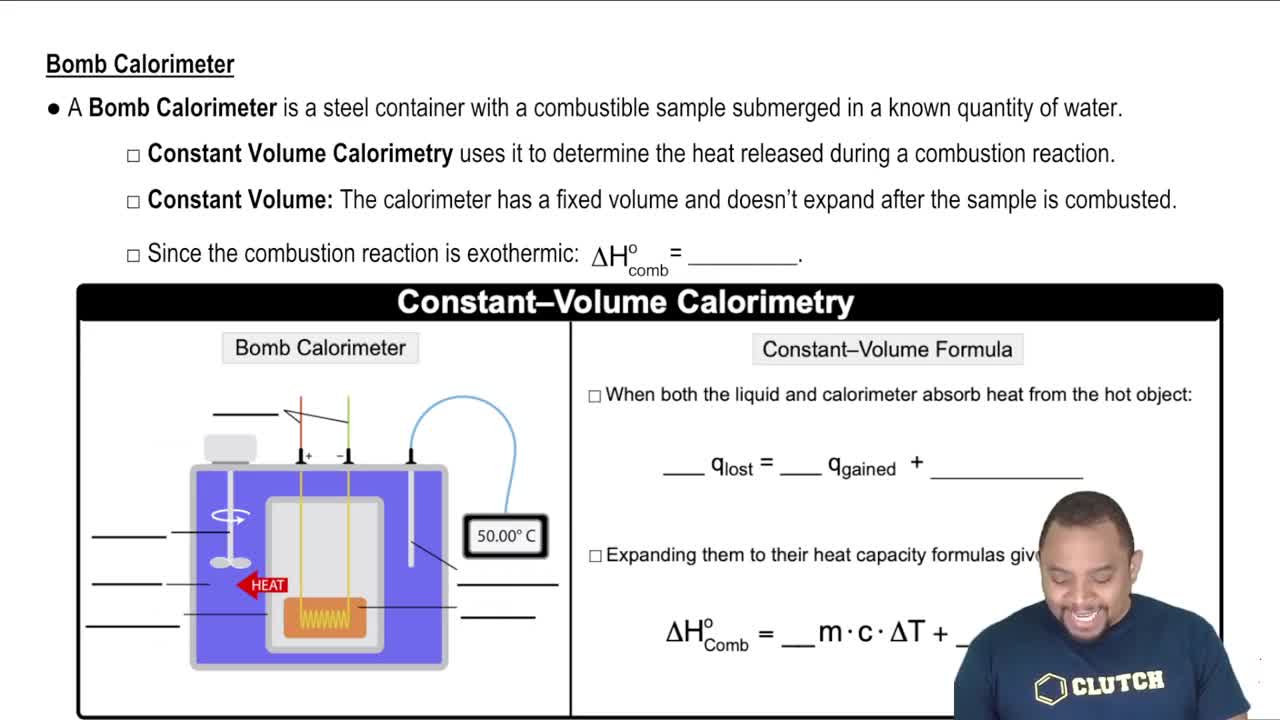
Constant-Volume Calorimetry
Pratica correlata
Domanda del libro di testo

(d) Lithium is not nearly as abundant as sodium. If sodium ion batteries were developed that function in the same manner as lithium ion batteries, do you think 'sodium cobalt oxide' would still work as the electrode material? Explain.

504
views
Domanda del libro di testo

The ionic substance strontium oxide, SrO, forms from the reaction of strontium metal with molecular oxygen. The arrangement of the ions in solid SrO is analogous to that in solid NaCl: (a) Write a balanced equation for the formation of SrO(s) from its elements.

1034
views
Domanda del libro di testo
Note from the following table that there is a significant increase in atomic radius upon moving from Y to La, whereas the radii of Zr to Hf are the same. Suggest an explanation for this effect. Atomic Radii (pm) Sc 170 Ti 160 Y 190 Zr 175 La 207 Hf 175
971
views
Domanda del libro di testo

The ionic substance strontium oxide, SrO, forms from the reaction of strontium metal with molecular oxygen. The arrangement of the ions in solid SrO is analogous to that in solid NaCl:

(b) Based on the ionic radii in Figure 7.8, predict the length of the side of the cube in the figure (the distance from the center of an atom at one corner to the center of an atom at a neighboring corner).

966
views
Domanda del libro di testo

Elements in group 7A in the periodic table are called the halogens; elements in group 6A are called the chalcogens. (a) What is the most common oxidation state of the chalcogens compared to the halogens?

1811
views