
Using Lewis symbols and Lewis structures, make a sketch of the formation of NCl3 from N and Cl atoms, showing valence-shell electrons. (a) How many valence electrons does N have initially? (c) How many valence electrons surround the N in the NCl3 molecule? (d) How many valence electrons surround each Cl in the NCl3 molecule?
Ch.8 - Basic Concepts of Chemical Bonding
Brown14th EditionChemistry: The Central ScienceISBN: 9780134414232Non è quello che usi tu?Cambia libro di testo
Capitolo 8, Problema 31a
(a) State whether or not the bonding in each substance is likely to be covalent: (i) glucose, (ii) nitrogen, (iii) aluminum hydroxide, (iv) ammonia, (v) neon.
Guida verificata passo dopo passo1
To determine if the bonding in a substance is likely to be covalent, consider the types of elements involved. Covalent bonds typically form between nonmetals.
Examine glucose (C₆H₁₂O₆): Glucose is composed of carbon, hydrogen, and oxygen, all of which are nonmetals. Therefore, the bonding in glucose is likely covalent.
Consider nitrogen (N₂): Nitrogen is a diatomic molecule consisting of two nitrogen atoms, both nonmetals. The bonding in nitrogen is covalent.
Analyze aluminum hydroxide (Al(OH)₃): Aluminum is a metal, while hydroxide is composed of oxygen and hydrogen, which are nonmetals. The bonding in aluminum hydroxide is likely ionic due to the presence of a metal.
Evaluate ammonia (NH₃): Ammonia consists of nitrogen and hydrogen, both nonmetals. Thus, the bonding in ammonia is covalent.
Assess neon (Ne): Neon is a noble gas and typically does not form bonds because it is chemically inert. Therefore, there is no covalent bonding in neon.

Risposta video verificata per un problema simile:
Questa soluzione video è stata consigliata dai nostri tutor come utile per risolvere questo problema.
Durata del video:
5mConcetti chiave
Ecco i concetti essenziali che devi comprendere per rispondere correttamente alla domanda.
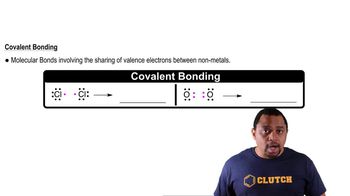
Covalent Bonding
Covalent bonding occurs when two atoms share one or more pairs of electrons, typically between nonmetals. This type of bond results in the formation of molecules, where the shared electrons allow each atom to achieve a more stable electron configuration, often resembling that of noble gases. Understanding the nature of covalent bonds is essential for determining the bonding characteristics of various substances.
Video consigliato:
Percorso guidato
Chemical Bonds
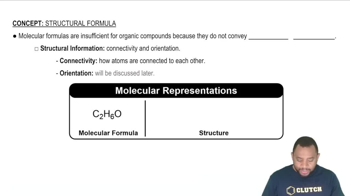
Molecular Structure
The molecular structure of a substance refers to the arrangement of atoms within a molecule and the types of bonds that hold them together. This structure influences the physical and chemical properties of the substance, including its reactivity and state of matter. Analyzing the molecular structure helps in identifying whether a substance is likely to exhibit covalent bonding.
Video consigliato:
Percorso guidato
Molecular Formula
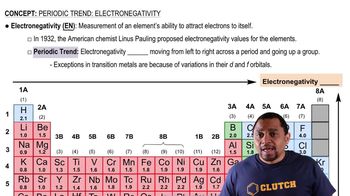
Electronegativity
Electronegativity is a measure of an atom's ability to attract and hold onto electrons in a bond. In covalent bonds, the difference in electronegativity between the bonded atoms can indicate the bond's character; small differences suggest nonpolar covalent bonds, while larger differences can lead to polar covalent bonds. Understanding electronegativity is crucial for predicting the type of bonding in various substances.
Video consigliato:
Percorso guidato
Electronegativity Trends
Pratica correlata
Domanda del libro di testo
List the individual steps used in constructing a Born–Haber cycle for the formation of BaI2 from the elements. Which of the steps would you expect to be exothermic?
1089
views
Domanda del libro di testo
(a) Based on the lattice energies of MgCl2 and SrCl2 given in Table 8.1, what is the range of values that you would expect for the lattice energy of CaCl2?
1342
views
Domanda del libro di testo
(b) Using data from Appendix C, Figure 7.11, Figure 7.13, and the value of the second ionization energy for Ca, 1145 kJ/mol, calculate the lattice energy of CaCl2.
699
views
Domanda del libro di testo
(b) A substance, XY, formed from two different elements, melts at −33 °C. Is XY likely to be a covalent or an ionic substance?
431
views
