Ch.8 - Basic Concepts of Chemical Bonding
Brown - Chemistry: The Central Science 14th Edition
Brown14th EditionChemistry: The Central ScienceISBN: 9780134414232Non è quello che usi tu?Cambia libro di testo
Capitolo 8, Problema 33a,c,d

Using Lewis symbols and Lewis structures, make a sketch of the formation of NCl3 from N and Cl atoms, showing valence-shell electrons. (a) How many valence electrons does N have initially? (c) How many valence electrons surround the N in the NCl3 molecule? (d) How many valence electrons surround each Cl in the NCl3 molecule?

Guida verificata passo dopo passo
1
Identify the number of valence electrons for each atom: Nitrogen (N) is in group 15 of the periodic table and has 5 valence electrons. Chlorine (Cl) is in group 17 and has 7 valence electrons.
Draw the Lewis symbol for a nitrogen atom, which consists of the symbol 'N' surrounded by 5 dots representing its valence electrons.
Draw the Lewis symbol for a chlorine atom, which consists of the symbol 'Cl' surrounded by 7 dots representing its valence electrons.
To form NCl3, nitrogen will share one of its valence electrons with each of the three chlorine atoms, forming three N-Cl single bonds. Each bond is represented by a pair of shared electrons (a line) between N and Cl in the Lewis structure.
In the NCl3 molecule, nitrogen is surrounded by 8 valence electrons (3 from the bonds and 5 of its own), and each chlorine atom is surrounded by 8 valence electrons (1 from the bond and 7 of its own).

Risposta video verificata per un problema simile:

Questa soluzione video è stata consigliata dai nostri tutor come utile per risolvere questo problema.
Durata del video:
1m

Concetti chiave

Ecco i concetti essenziali che devi comprendere per rispondere correttamente alla domanda.

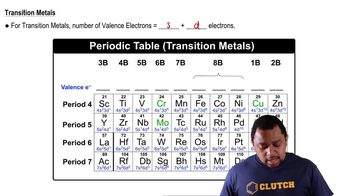
Valence Electrons

Valence electrons are the outermost electrons of an atom and are crucial for determining how an atom interacts with others. For nitrogen (N), there are five valence electrons, while chlorine (Cl) has seven. These electrons participate in chemical bonding, allowing atoms to achieve stable electron configurations through sharing or transferring electrons.
Video consigliato:
Percorso guidato
02:12
Transition Metals Valence Electrons

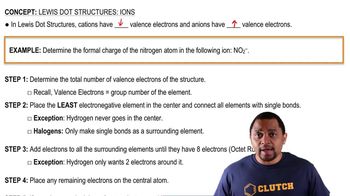
Lewis Structures

Lewis structures are diagrams that represent the bonding between atoms in a molecule and the lone pairs of electrons that may exist. They use dots to represent valence electrons and lines to indicate bonds between atoms. In the case of NCl3, the Lewis structure illustrates how nitrogen shares its electrons with three chlorine atoms to form covalent bonds, achieving a stable configuration.
Video consigliato:
Percorso guidato
04:28
Lewis Dot Structures: Ions

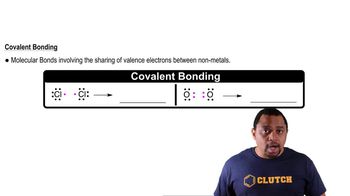
Covalent Bonding

Covalent bonding occurs when two atoms share one or more pairs of electrons, allowing them to achieve full outer electron shells. In NCl3, nitrogen forms three covalent bonds with three chlorine atoms, sharing its five valence electrons to complete its octet, while each chlorine atom also achieves a stable configuration by sharing electrons with nitrogen.
Video consigliato: