Ch.9 - Molecular Geometry and Bonding Theories
Brown - Chemistry: The Central Science 14th Edition
Brown14th EditionChemistry: The Central ScienceISBN: 9780134414232Non è quello che usi tu?Cambia libro di testo
Capitolo 9, Problema 95

The O-H bond lengths in the water molecule 1H2O are 96 pm, and the H-O-H angle is 104.5°. The dipole moment of the water molecule is 1.85 D. (c) Compare your answer from part (b) to the dipole moments of the hydrogen halides (Table 8.3). Is your answer in accord with the relative electronegativity of oxygen?

Guida verificata passo dopo passo
1
First, understand the concept of dipole moment. The dipole moment ( μ ) is a measure of the separation of positive and negative charges in a molecule. It is calculated using the formula: μ = q × d , where q is the charge and d is the distance between charges.
Next, consider the electronegativity of oxygen compared to hydrogen halides. Electronegativity is the ability of an atom to attract electrons in a bond. Oxygen is more electronegative than hydrogen, which contributes to the dipole moment in water.
Review Table 8.3 to find the dipole moments of hydrogen halides such as HF, HCl, HBr, and HI. Compare these values to the dipole moment of water (1.85 D).
Analyze the trend: Generally, the dipole moment decreases as the electronegativity difference between hydrogen and the halide decreases. Oxygen's high electronegativity compared to hydrogen results in a significant dipole moment for water.
Conclude whether the dipole moment of water is consistent with the relative electronegativity of oxygen. Since oxygen is highly electronegative, the dipole moment of water should be relatively high compared to hydrogen halides, which aligns with the data from Table 8.3.

Concetti chiave

Ecco i concetti essenziali che devi comprendere per rispondere correttamente alla domanda.

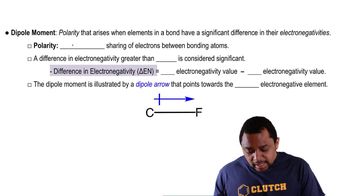
Dipole Moment

The dipole moment is a measure of the separation of positive and negative charges in a molecule, indicating its polarity. It is a vector quantity, represented in Debye (D), and is influenced by both the bond lengths and the angles between bonds. A higher dipole moment suggests a greater polarity, which is crucial for understanding molecular interactions and properties.
Video consigliato:

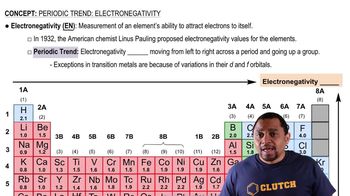
Electronegativity

Electronegativity is the tendency of an atom to attract electrons in a chemical bond. It is a key factor in determining the polarity of a bond; for example, in water, oxygen is more electronegative than hydrogen, leading to a polar O-H bond. The relative electronegativities of elements can help predict the dipole moments of molecules, as more electronegative atoms will create stronger dipoles.
Video consigliato:
Percorso guidato
02:10
Electronegativity Trends

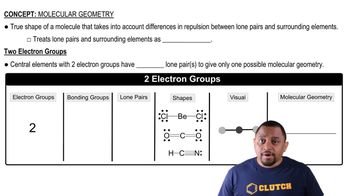
Molecular Geometry

Molecular geometry refers to the three-dimensional arrangement of atoms within a molecule, which affects its physical and chemical properties. In water, the bent shape due to the H-O-H angle of 104.5° contributes to its dipole moment. Understanding molecular geometry is essential for predicting how molecules interact with each other and their environment.
Video consigliato:
Percorso guidato
01:33
Molecular Geometry with Two Electron Groups