Ch.9 - Molecular Geometry and Bonding Theories
Brown - Chemistry: The Central Science 14th Edition
Brown14th EditionChemistry: The Central ScienceISBN: 9780134414232Non è quello che usi tu?Cambia libro di testo
Capitolo 9, Problema 68

What hybridization do you expect for the atom that is underlined in each of the following species? (a) IO2- (b) NH4+ (c) SCN- (d) BrCl3

Guida verificata passo dopo passo
1
Identify the central atom in the species, which is iodine (I) in IO_2^-.
Determine the number of valence electrons for iodine. Iodine has 7 valence electrons.
Consider the charge of the ion. The negative charge (1-) indicates an additional electron, making it 8 valence electrons to distribute.
Count the number of atoms bonded to iodine. There are two oxygen atoms bonded to iodine.
Use the formula for hybridization: Hybridization = (Number of sigma bonds + Number of lone pairs). Calculate the hybridization based on the number of sigma bonds and lone pairs around iodine.

Risposta video verificata per un problema simile:

Questa soluzione video è stata consigliata dai nostri tutor come utile per risolvere questo problema.
Durata del video:
58s

Concetti chiave

Ecco i concetti essenziali che devi comprendere per rispondere correttamente alla domanda.

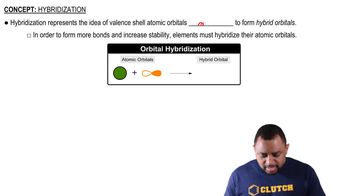
Hybridization

Hybridization is a concept in chemistry that describes the mixing of atomic orbitals to form new hybrid orbitals. These hybrid orbitals are used to explain the geometry of molecular bonding. The type of hybridization depends on the number of electron pairs around the central atom, which can include both bonding pairs and lone pairs.
Video consigliato:

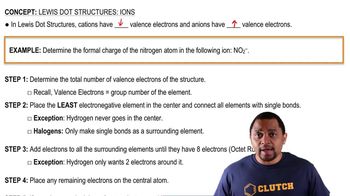
Lewis Structures

Lewis structures are diagrams that represent the bonding between atoms in a molecule and the lone pairs of electrons that may exist. They help visualize the arrangement of electrons and can be used to determine the hybridization of atoms. By drawing the Lewis structure for IO2-, one can identify the number of electron domains around the iodine atom, which is crucial for determining its hybridization.
Video consigliato:
Percorso guidato
04:28
Lewis Dot Structures: Ions

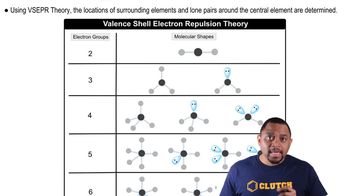
VSEPR Theory

Valence Shell Electron Pair Repulsion (VSEPR) theory is a model used to predict the geometry of individual molecules based on the repulsion between electron pairs. According to VSEPR, electron pairs will arrange themselves to minimize repulsion, which directly influences the hybridization of the central atom. Understanding VSEPR helps in predicting the shape of the IO2- ion and thus its hybridization.
Video consigliato:
Percorso guidato
02:13
Molecular Shapes and VSEPR