Ch.9 - Molecular Geometry and Bonding Theories
Brown - Chemistry: The Central Science 14th Edition
Brown14th EditionChemistry: The Central ScienceISBN: 9780134414232Non è quello che usi tu?Cambia libro di testo
Capitolo 9, Problema 11c1

For each of these contour representations of molecular orbitals, identify (c) whether the MO is bonding or antibonding (i)
Contour representations of molecular orbitals for bonding and antibonding identification.

Guida verificata passo dopo passo
1
Step 1: Identify the molecular orbitals (MOs) in the image. There are three MOs labeled (i), (ii), and (iii).
Step 2: For MO (i), observe the overlap of the atomic orbitals. The constructive overlap (same phase) between the orbitals indicates a bonding MO.
Step 3: For MO (ii), observe the overlap of the atomic orbitals. The destructive overlap (opposite phase) between the orbitals indicates an antibonding MO.
Step 4: For MO (iii), observe the overlap of the atomic orbitals. The constructive overlap (same phase) between the orbitals indicates a bonding MO.
Step 5: Summarize the findings: MO (i) is bonding, MO (ii) is antibonding, and MO (iii) is bonding.

Risposta video verificata per un problema simile:

Questa soluzione video è stata consigliata dai nostri tutor come utile per risolvere questo problema.
Durata del video:
1m

Concetti chiave

Ecco i concetti essenziali che devi comprendere per rispondere correttamente alla domanda.

Molecular Orbitals (MOs)

Molecular orbitals are formed by the combination of atomic orbitals when atoms bond together. They can be classified as bonding or antibonding. Bonding MOs have lower energy and increase the stability of a molecule, while antibonding MOs have higher energy and can destabilize the molecule. Understanding the shape and energy of these orbitals is crucial for predicting molecular behavior.
Video consigliato:
Percorso guidato
03:06
Molecular Orbital Theory

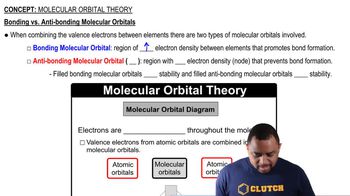
Bonding vs. Antibonding Orbitals

Bonding orbitals are characterized by an increased electron density between the nuclei of two atoms, which helps to hold the atoms together. In contrast, antibonding orbitals have a node between the nuclei, leading to decreased electron density in that region, which can weaken or prevent bond formation. Identifying these orbitals is essential for understanding molecular stability and reactivity.
Video consigliato:
Percorso guidato
03:06
Molecular Orbital Theory

Contour Representations

Contour representations visually depict the regions of space where electrons are likely to be found in molecular orbitals. The shapes and colors in these diagrams indicate areas of high and low electron density. By analyzing these representations, one can determine whether an orbital is bonding or antibonding based on the overlap and arrangement of the lobes.
Video consigliato:
Percorso guidato
02:32
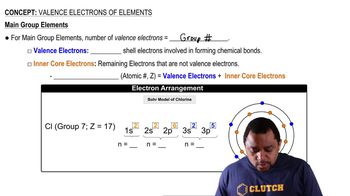
Main Group Elements Valence Electrons