Ch.1 - Introduction: Matter, Energy, and Measurement
Brown - Chemistry: The Central Science 15th Edition
Brown15th EditionChemistry: The Central ScienceISBN: 9780137542970Non è quello che usi tu?Cambia libro di testo
Capitolo 1, Problema 60a

Carry out the following conversions: (a) 0.105 in. to mm

Guida verificata passo dopo passo
1
Start by identifying the conversion factors needed. We know that 1 inch is equal to 2.54 centimeters.
Convert inches to centimeters using the conversion factor: 0.105 \(\text{ in}\) \(\times\) \(\frac{2.54 \text{ cm}\)}{1 \(\text{ in}\)}.
Now, convert centimeters to millimeters. Remember that 1 centimeter is equal to 10 millimeters.
Use the conversion factor to convert centimeters to millimeters: \(\text{result in cm}\) \(\times\) \(\frac{10 \text{ mm}\)}{1 \(\text{ cm}\)}.
Combine the steps to find the final conversion from inches to millimeters.

Risposta video verificata per un problema simile:

Questa soluzione video è stata consigliata dai nostri tutor come utile per risolvere questo problema.
Durata del video:
2m

Concetti chiave

Ecco i concetti essenziali che devi comprendere per rispondere correttamente alla domanda.

Unit Conversion

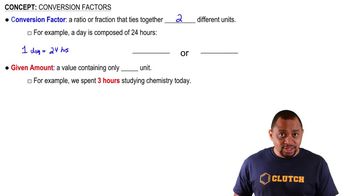
Unit conversion is the process of converting a quantity expressed in one unit to another unit. This involves using conversion factors, which are ratios that express how many of one unit are equivalent to another. For example, to convert inches to millimeters, one can use the conversion factor that 1 inch equals 25.4 millimeters.
Video consigliato:
Percorso guidato
01:56
Conversion Factors

Metric System

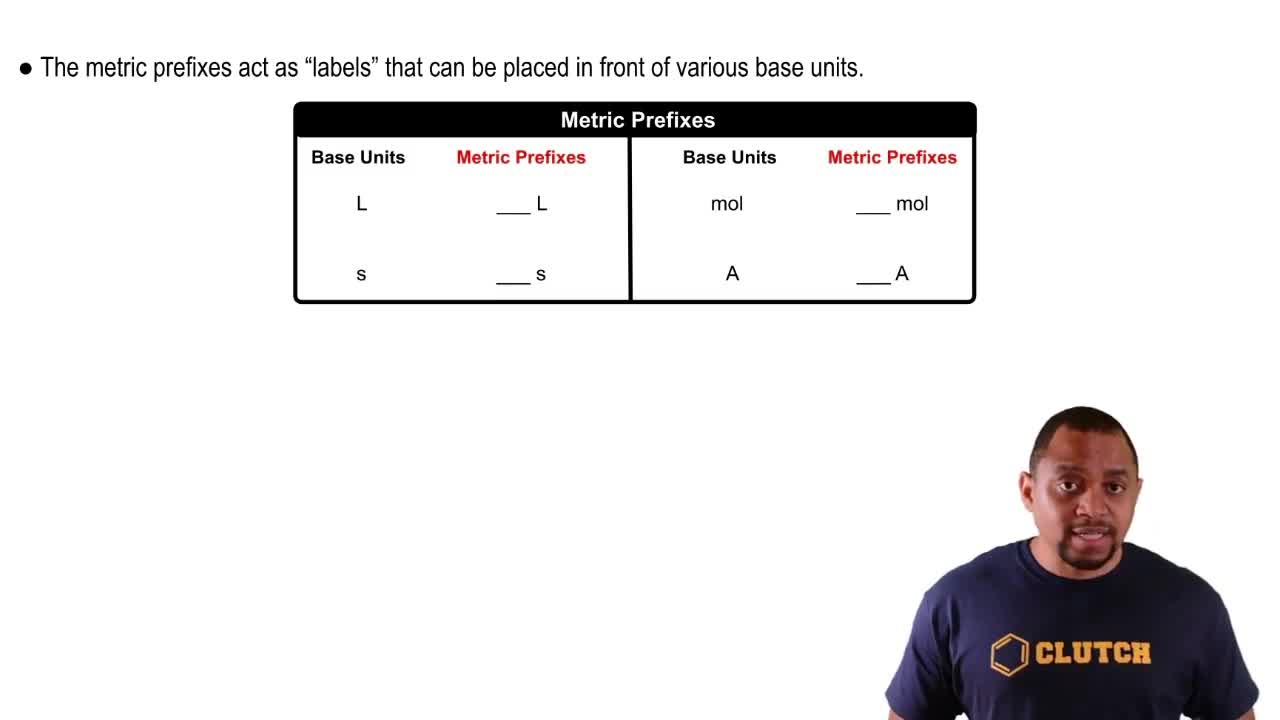
The metric system is an internationally recognized decimal system of measurement based on powers of ten. It includes units such as meters for length, grams for mass, and liters for volume. Understanding the metric system is essential for performing conversions, as it provides a standardized framework for measuring and comparing quantities.
Video consigliato:
Percorso guidato
01:16
Metric Prefixes Usage

Dimensional Analysis

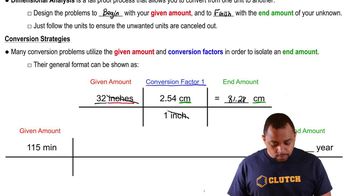
Dimensional analysis is a mathematical technique used to convert one set of units to another by multiplying by conversion factors. It ensures that the units cancel appropriately, leading to the desired unit in the final answer. This method is particularly useful in chemistry and physics for ensuring that equations are dimensionally consistent.
Video consigliato:
Percorso guidato
06:11
Dimensional Analysis