Ch.1 - Introduction: Matter, Energy, and Measurement
Brown - Chemistry: The Central Science 15th Edition
Brown15th EditionChemistry: The Central ScienceISBN: 9780137542970Non è quello che usi tu?Cambia libro di testo
Capitolo 1, Problema 60d

Carry out the following conversions: (d) 1.955 m3 to yd3

Guida verificata passo dopo passo
1
Identify the conversion factors needed: 1 meter (m) = 1.09361 yards (yd). Therefore, 1 cubic meter (m^3) = (1.09361 yd)^3.
Calculate the conversion factor for cubic meters to cubic yards: (1.09361 yd)^3 = 1.09361^3 yd^3.
Multiply the given volume in cubic meters by the conversion factor to convert to cubic yards: 1.955 m^3 * (1.09361^3 yd^3/m^3).
Simplify the expression to find the volume in cubic yards.
Ensure the units are correctly converted and the final answer is expressed in yd^3.

Risposta video verificata per un problema simile:

Questa soluzione video è stata consigliata dai nostri tutor come utile per risolvere questo problema.
Durata del video:
1m

Concetti chiave

Ecco i concetti essenziali che devi comprendere per rispondere correttamente alla domanda.

Volume Units

Volume is a measure of the three-dimensional space an object occupies, commonly expressed in units such as cubic meters (m³) and cubic yards (yd³). Understanding these units is essential for converting between different volume measurements, as they represent different scales of volume.
Video consigliato:
Percorso guidato
02:35
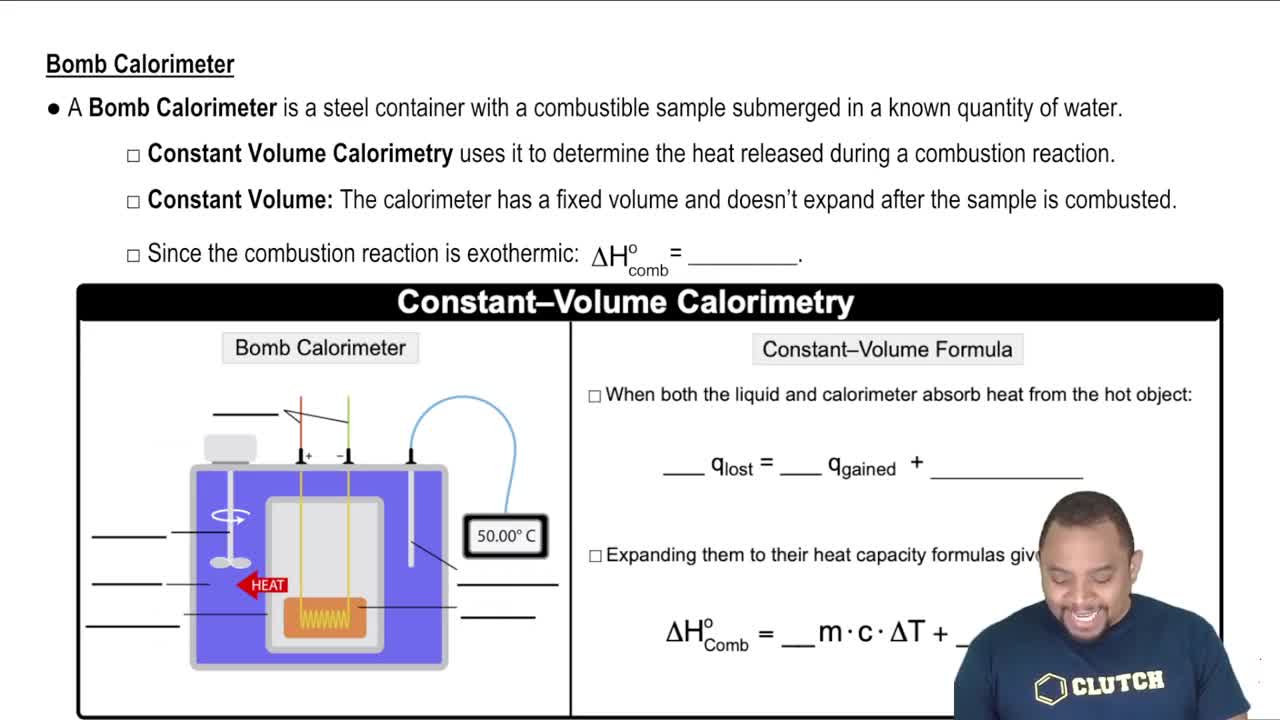
Constant-Volume Calorimetry

Unit Conversion

Unit conversion involves changing a quantity expressed in one unit to another unit without changing its value. This process often requires a conversion factor, which is a numerical multiplier that relates the two units. For example, knowing that 1 m³ is approximately equal to 1.30795 yd³ allows for accurate conversions between these volume units.
Video consigliato:
Percorso guidato
01:56
Conversion Factors

Dimensional Analysis

Dimensional analysis is a mathematical technique used to convert one set of units to another by multiplying by conversion factors. This method ensures that units cancel appropriately, leading to the desired unit in the final answer. It is a crucial skill in chemistry and physics for ensuring that calculations are dimensionally consistent.
Video consigliato:
Percorso guidato
06:11
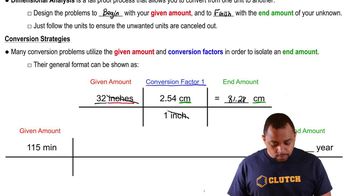
Dimensional Analysis