Ch.1 - Introduction: Matter, Energy, and Measurement
Brown - Chemistry: The Central Science 15th Edition
Brown15th EditionChemistry: The Central ScienceISBN: 9780137542970Non è quello che usi tu?Cambia libro di testo
Capitolo 1, Problema 59e

Perform the following conversions: (e) 22.50 gal/min to L/s

Guida verificata passo dopo passo
1
Identify the conversion factors needed: 1 gallon = 3.78541 liters and 1 minute = 60 seconds.
Convert gallons to liters using the conversion factor: multiply 22.50 gal/min by 3.78541 L/gal.
Convert minutes to seconds by dividing the result from the previous step by 60 seconds/min.
Combine the conversions to express the flow rate in liters per second (L/s).
Ensure the units cancel appropriately, leaving you with the desired unit of L/s.

Risposta video verificata per un problema simile:

Questa soluzione video è stata consigliata dai nostri tutor come utile per risolvere questo problema.
Durata del video:
3m

Concetti chiave

Ecco i concetti essenziali che devi comprendere per rispondere correttamente alla domanda.

Unit Conversion

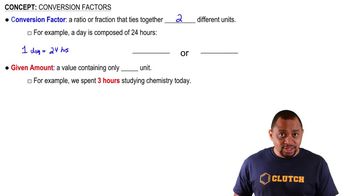
Unit conversion is the process of converting a quantity expressed in one set of units to another. This involves using conversion factors, which are ratios that express how many of one unit are equivalent to another. For example, to convert gallons to liters, one must know that 1 gallon is approximately 3.78541 liters.
Video consigliato:
Percorso guidato
01:56
Conversion Factors

Flow Rate

Flow rate is a measure of the volume of fluid that passes through a given surface per unit of time. It is commonly expressed in units such as gallons per minute (gal/min) or liters per second (L/s). Understanding flow rate is essential in various applications, including engineering and environmental science, as it helps in assessing the efficiency of fluid systems.
Video consigliato:
Percorso guidato
01:30
Instantaneous Rate

Metric and Imperial Units

Metric and imperial units are two different systems of measurement. The metric system, used widely in science, is based on units like liters and meters, while the imperial system includes units like gallons and feet. Familiarity with both systems is crucial for performing conversions accurately, especially in scientific contexts where precise measurements are necessary.
Video consigliato:
Percorso guidato
01:16
Metric Prefixes Usage