
Ch.14 - Chemical Kinetics
Brown - Chemistry: The Central Science 15th Edition
Brown15th EditionChemistry: The Central ScienceISBN: 9780137542970Non è quello che usi tu?Cambia libro di testo
Capitolo 14, Problema 75a,b

(a) What is a catalyst? (b) What is the difference between a homogeneous and a heterogeneous catalyst?

Guida verificata passo dopo passo
1
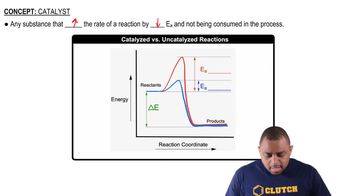
A catalyst is a substance that increases the rate of a chemical reaction without being consumed in the process. It works by providing an alternative reaction pathway with a lower activation energy.
Homogeneous catalysts are in the same phase as the reactants, typically in a solution. This allows them to interact more easily with the reactants, often forming intermediate compounds.
Heterogeneous catalysts are in a different phase than the reactants, usually solid catalysts in contact with gaseous or liquid reactants. The reaction occurs on the surface of the catalyst.
In homogeneous catalysis, the catalyst can be more easily mixed with the reactants, which can lead to a more uniform reaction environment. However, separation of the catalyst from the products can be challenging.
In heterogeneous catalysis, the catalyst can be easily separated from the reaction mixture, which is advantageous for industrial processes. However, the reaction is limited to the surface area of the catalyst.

Risposta video verificata per un problema simile:

Questa soluzione video è stata consigliata dai nostri tutor come utile per risolvere questo problema.
Durata del video:
2m

Concetti chiave

Ecco i concetti essenziali che devi comprendere per rispondere correttamente alla domanda.

Catalyst

A catalyst is a substance that increases the rate of a chemical reaction without being consumed in the process. It works by providing an alternative reaction pathway with a lower activation energy, allowing reactants to convert to products more efficiently. Catalysts are crucial in both industrial processes and biological systems, where they facilitate reactions that would otherwise occur too slowly.
Video consigliato:
Percorso guidato
01:59
Catalyzed vs. Uncatalyzed Reactions

Homogeneous Catalyst

A homogeneous catalyst is one that exists in the same phase (solid, liquid, or gas) as the reactants in a chemical reaction. This uniformity allows for better interaction between the catalyst and the reactants, often leading to more efficient reactions. An example is the use of sulfuric acid in the esterification of alcohols, where both the catalyst and reactants are in the liquid phase.
Video consigliato:
Percorso guidato
01:59
Catalyzed vs. Uncatalyzed Reactions

Heterogeneous Catalyst

A heterogeneous catalyst is one that is in a different phase than the reactants, typically solid catalysts interacting with gaseous or liquid reactants. This phase difference can lead to distinct reaction mechanisms, often involving adsorption of reactants onto the catalyst surface. An example is the use of platinum in catalytic converters, where the solid metal facilitates the conversion of gaseous pollutants into less harmful substances.
Video consigliato:
Percorso guidato
01:59
Catalyzed vs. Uncatalyzed Reactions