
Ch.14 - Chemical Kinetics
Brown - Chemistry: The Central Science 15th Edition
Brown15th EditionChemistry: The Central ScienceISBN: 9780137542970Non è quello che usi tu?Cambia libro di testo
Capitolo 14, Problema 75c

(c) Do catalysts affect the overall enthalpy change for a reaction, the activation energy, or both?

Guida verificata passo dopo passo
1
Understand the role of a catalyst: A catalyst is a substance that increases the rate of a chemical reaction without being consumed in the process.
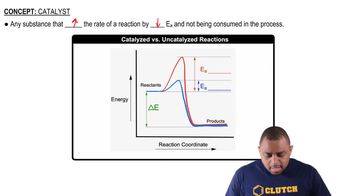
Identify the effect on activation energy: Catalysts work by providing an alternative reaction pathway with a lower activation energy compared to the uncatalyzed reaction.
Analyze the effect on overall enthalpy change (ΔH): The overall enthalpy change for a reaction is determined by the properties of the reactants and products and is independent of the pathway taken from reactants to products.
Conclude the specific effect of catalysts: Catalysts affect the activation energy of a reaction but do not alter the overall enthalpy change of the reaction.
Apply this understanding: In practical applications, using a catalyst can make a reaction more feasible by lowering the energy barrier (activation energy), but it will not change the energy released or absorbed (enthalpy change) by the reaction.

Risposta video verificata per un problema simile:

Questa soluzione video è stata consigliata dai nostri tutor come utile per risolvere questo problema.
Durata del video:
2m

Concetti chiave

Ecco i concetti essenziali che devi comprendere per rispondere correttamente alla domanda.

Catalysts

Catalysts are substances that increase the rate of a chemical reaction without being consumed in the process. They work by providing an alternative reaction pathway with a lower activation energy, allowing more reactant molecules to participate in the reaction at a given temperature.
Video consigliato:
Percorso guidato
01:59
Catalyzed vs. Uncatalyzed Reactions

Enthalpy Change

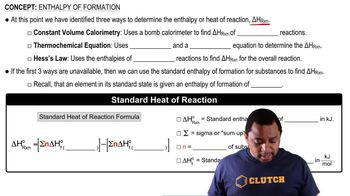
Enthalpy change refers to the heat content change of a system during a chemical reaction at constant pressure. It is a state function that depends only on the initial and final states of the reactants and products, and is not influenced by the pathway taken, including the presence of a catalyst.
Video consigliato:
Percorso guidato
02:34
Enthalpy of Formation

Activation Energy

Activation energy is the minimum energy required for a chemical reaction to occur. Catalysts lower the activation energy barrier, making it easier for reactants to convert into products, thus speeding up the reaction without altering the overall enthalpy change.
Video consigliato:
Percorso guidato
02:02
Activity Series Chart