
Ch.15 - Chemical Equilibrium
Brown - Chemistry: The Central Science 15th Edition
Brown15th EditionChemistry: The Central ScienceISBN: 9780137542970Non è quello che usi tu?Cambia libro di testo
Capitolo 15, Problema 79

For the equilibrium 2 IBr(g) ⇌ I2(g) + Br2(g), Kp = 8.5 * 10^-3 at 150 _x001F_C. If 0.025 atm of IBr is placed in a 2.0-L container, what is the partial pressure of all substances after equilibrium is reached?

Guida verificata passo dopo passo
1
Step 1: Write the expression for the equilibrium constant Kp for the reaction 2 IBr(g) ⇌ I2(g) + Br2(g). The expression is Kp = (P_{I2} * P_{Br2}) / (P_{IBr}^2), where P represents the partial pressures of the gases.
Step 2: Define the initial conditions. Initially, the partial pressure of IBr is 0.025 atm, and the partial pressures of I2 and Br2 are 0 atm since they are not present initially.
Step 3: Set up an ICE (Initial, Change, Equilibrium) table to track the changes in partial pressures. Let x be the change in pressure for I2 and Br2, and 2x for IBr since it dissociates into two moles of IBr for every mole of I2 and Br2 formed.
Step 4: Express the equilibrium partial pressures in terms of x. At equilibrium, P_{IBr} = 0.025 - 2x, P_{I2} = x, and P_{Br2} = x.
Step 5: Substitute the equilibrium partial pressures into the Kp expression and solve for x. Use the equation Kp = (x * x) / (0.025 - 2x)^2 = 8.5 * 10^-3 to find the value of x, which will allow you to calculate the equilibrium partial pressures of IBr, I2, and Br2.

Concetti chiave

Ecco i concetti essenziali che devi comprendere per rispondere correttamente alla domanda.

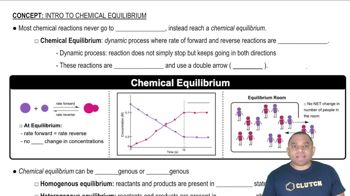
Chemical Equilibrium

Chemical equilibrium occurs when the rates of the forward and reverse reactions are equal, resulting in constant concentrations of reactants and products. In this state, the system is dynamic, meaning that reactions continue to occur, but there is no net change in the concentrations. The equilibrium constant (Kp) quantifies the ratio of the partial pressures of products to reactants at equilibrium, providing insight into the position of the equilibrium.
Video consigliato:
Percorso guidato
04:21
Chemical Equilibrium Concepts

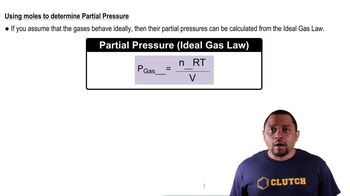
Partial Pressure

Partial pressure is the pressure exerted by a single component of a gas mixture. According to Dalton's Law, the total pressure of a gas mixture is the sum of the partial pressures of its individual gases. In equilibrium calculations, understanding how to calculate the partial pressures of each species is crucial for determining the equilibrium state of the system.
Video consigliato:
Percorso guidato
00:48
Partial Pressure Calculation

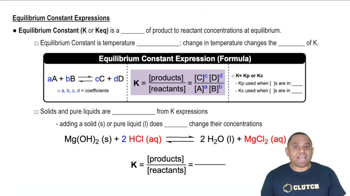
Equilibrium Constant (Kp)

The equilibrium constant (Kp) is a dimensionless value that expresses the ratio of the partial pressures of products to reactants at equilibrium, raised to the power of their stoichiometric coefficients. For the reaction 2 IBr(g) ⇌ I2(g) + Br2(g), Kp = (P_I2 * P_Br2) / (P_IBr^2). This constant helps predict the direction of the reaction and the concentrations of the substances at equilibrium, given initial conditions.
Video consigliato:
Percorso guidato
03:20
Equilibrium Constant Expressions
Pratica correlata
Domanda del libro di testo

A 0.831-g sample of SO3 is placed in a 1.00-L container and heated to 1100 K. The SO3 decomposes to SO2 and O2: 2SO3(𝑔) ⇌ 2 SO2(𝑔) + O2(𝑔) At equilibrium, the total pressure in the container is 1.300 atm. Find the values of 𝐾𝑝 and 𝐾𝑐 for this reaction at 1100 K.

1351
views
Domanda del libro di testo

Consider the hypothetical reaction A(𝑔) ⇌ 2 B(𝑔). A flask is charged with 0.75 atm of pure A, after which it is allowed to reach equilibrium at 0°C. At equilibrium, the partial pressure of A is 0.36 atm. (c) To maximize the yield of product B, would you make the reaction flask larger or smaller?

Domanda del libro di testo

For the equilibrium PH3BCl3(𝑠) ⇌ PH3(𝑔) + BCl3(𝑔) 𝐾𝑝 = 0.052 at 60°C. (b) A closed 1.500-L vessel at 60°C is charged with 0.0500 g of BCl3(𝑔); 3.00 g of solid PH3BCl3 is then added to the flask, and the system is allowed to equilibrate. What is the equilibrium concentration of PH3?

Domanda del libro di testo

As shown in Table 15.2, the equilibrium constant for the reaction N2(g) + 3 H2(g) ⇌ 2 NH3(g) is Kp = 4.34 × 10⁻³ at 300°C. Pure NH3 is placed in a 1.00-L flask and allowed to reach equilibrium at this temperature. There are 1.05 g NH3 in the equilibrium mixture. (b) What was the initial mass of ammonia placed in the vessel?

1061
views
Domanda del libro di testo

A sample of nitrosyl bromide (NOBr) decomposes according to the equation 2 NOBr(𝑔) ⇌ 2 NO(𝑔) + Br2(𝑔) An equilibrium mixture in a 5.00-L vessel at 100°C contains 3.22 g of NOBr, 2.46 g of NO, and 6.55 g of Br2. (c) What was the mass of the original sample of NOBr?