
Ch.15 - Chemical Equilibrium
Brown - Chemistry: The Central Science 15th Edition
Brown15th EditionChemistry: The Central ScienceISBN: 9780137542970Non è quello che usi tu?Cambia libro di testo
Capitolo 15, Problema 80b

For the equilibrium PH3BCl3(𝑠) ⇌ PH3(𝑔) + BCl3(𝑔) 𝐾𝑝 = 0.052 at 60°C. (b) A closed 1.500-L vessel at 60°C is charged with 0.0500 g of BCl3(𝑔); 3.00 g of solid PH3BCl3 is then added to the flask, and the system is allowed to equilibrate. What is the equilibrium concentration of PH3?

Guida verificata passo dopo passo
1
Convert the mass of BCl_3(g) to moles using its molar mass.
Calculate the initial pressure of BCl_3(g) using the ideal gas law: \( PV = nRT \).
Set up an ICE (Initial, Change, Equilibrium) table to track the changes in moles of each species as the system reaches equilibrium.
Express the equilibrium pressures of PH_3(g) and BCl_3(g) in terms of the change in moles, \( x \), and the initial pressure of BCl_3(g).
Use the equilibrium constant expression for \( K_p \) to solve for \( x \), which represents the change in moles of PH_3(g) at equilibrium.

Risposta video verificata per un problema simile:

Questa soluzione video è stata consigliata dai nostri tutor come utile per risolvere questo problema.
Durata del video:
4m

Concetti chiave

Ecco i concetti essenziali che devi comprendere per rispondere correttamente alla domanda.

Chemical Equilibrium

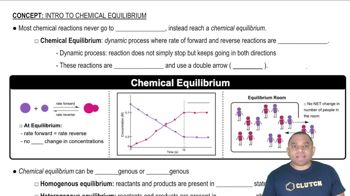
Chemical equilibrium occurs when the rates of the forward and reverse reactions are equal, resulting in constant concentrations of reactants and products. In this case, the equilibrium constant (Kp) quantifies the ratio of the partial pressures of the gaseous products to that of the solid reactant, indicating the extent of the reaction at a given temperature.
Video consigliato:
Percorso guidato
04:21
Chemical Equilibrium Concepts

Equilibrium Constant (Kp)

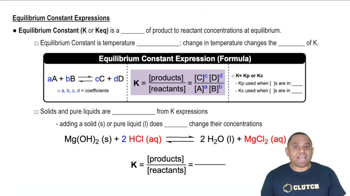
The equilibrium constant (Kp) is a dimensionless value that expresses the relationship between the concentrations of products and reactants at equilibrium for a gas-phase reaction. For the reaction PH3BCl3(s) ⇌ PH3(g) + BCl3(g), Kp = 0.052 indicates that at equilibrium, the concentration of gaseous products is relatively low compared to the solid reactant, influencing how much PH3 will be present in the system.
Video consigliato:
Percorso guidato
03:20
Equilibrium Constant Expressions

Molarity and Concentration Calculations

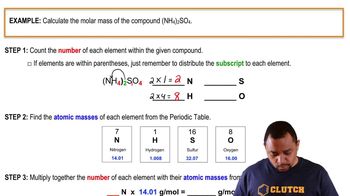
Molarity is a measure of concentration defined as the number of moles of solute per liter of solution. To find the equilibrium concentration of PH3, one must first convert the mass of BCl3 and PH3BCl3 into moles, then use the volume of the vessel to calculate the initial concentrations before applying the equilibrium expression to determine the final concentrations at equilibrium.
Video consigliato:
Percorso guidato
03:12
Molar Mass Calculation Example