
Ch.16 - Acid-Base Equilibria
Brown - Chemistry: The Central Science 15th Edition
Brown15th EditionChemistry: The Central ScienceISBN: 9780137542970Non è quello che usi tu?Cambia libro di testo
Capitolo 16, Problema 88a

Predict whether aqueous solutions of the following substances are acidic, basic, or neutral: (a) AlCl3

Guida verificata passo dopo passo
1
Step 1: Identify the type of compound. AlCl3 is a salt, which is formed from the reaction of an acid and a base. In this case, AlCl3 is formed from the reaction of Al(OH)3, a weak base, and HCl, a strong acid.
Step 2: Determine the potential hydrolysis reactions. Since AlCl3 is a salt, it can undergo hydrolysis, a reaction with water. The potential hydrolysis reactions are Al3+ + H2O -> Al(OH)2+ + H+ and Cl- + H2O -> HCl + OH-.
Step 3: Evaluate the likelihood of the hydrolysis reactions. The Al3+ ion can react with water to produce H+, making the solution acidic. The Cl- ion, however, is the conjugate base of a strong acid (HCl), so it will not react with water to produce OH-.
Step 4: Combine the results of the hydrolysis reactions. Since the Al3+ ion can react with water to produce H+ and the Cl- ion will not react with water to produce OH-, the solution will be acidic.
Step 5: Make the final prediction. Therefore, an aqueous solution of AlCl3 will be acidic.

Risposta video verificata per un problema simile:

Questa soluzione video è stata consigliata dai nostri tutor come utile per risolvere questo problema.
Durata del video:
3m

Concetti chiave

Ecco i concetti essenziali che devi comprendere per rispondere correttamente alla domanda.

Acid-Base Theory

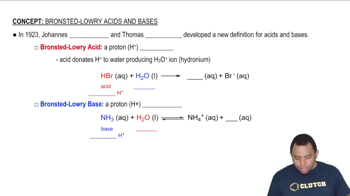
Acid-base theory explains how substances can donate or accept protons (H+ ions). According to the Brønsted-Lowry theory, acids are proton donors, while bases are proton acceptors. Understanding this concept is crucial for predicting the behavior of substances in solution, particularly how they affect the pH of the solution.
Video consigliato:
Percorso guidato
02:08
Bronsted-Lowry Acid-Base Theory

Hydrolysis of Salts

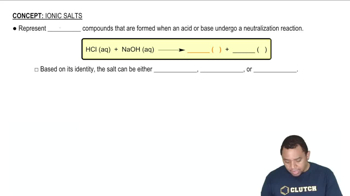
When salts dissolve in water, they can undergo hydrolysis, where the ions react with water to produce acidic or basic solutions. For example, cations from weak bases or anions from strong acids can lead to acidic solutions. In the case of AlCl3, the aluminum ion can hydrolyze to form H+ ions, contributing to acidity.
Video consigliato:

pH Scale

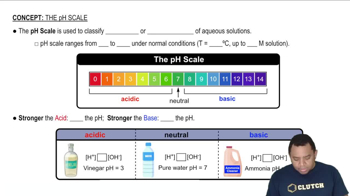
The pH scale measures the acidity or basicity of a solution, ranging from 0 (very acidic) to 14 (very basic), with 7 being neutral. A solution with a pH less than 7 is considered acidic, while a pH greater than 7 is basic. Understanding the pH scale is essential for predicting the nature of solutions formed by different substances, including salts like AlCl3.
Video consigliato: