Ch.16 - Acid-Base Equilibria
Brown - Chemistry: The Central Science 15th Edition
Brown15th EditionChemistry: The Central ScienceISBN: 9780137542970Non è quello che usi tu?Cambia libro di testo
Capitolo 16, Problema 88b

Predict whether aqueous solutions of the following substances are acidic, basic, or neutral: (b) NaBr

Guida verificata passo dopo passo
1
Step 1: Identify the ions that make up the compound. In this case, NaBr is made up of Na+ and Br- ions.
Step 2: Determine if either of these ions can act as an acid or a base. An acid is a substance that can donate a proton (H+), while a base is a substance that can accept a proton. In this case, Na+ is the cation of a strong base (NaOH), and Br- is the anion of a strong acid (HBr).
Step 3: Consider the behavior of these ions in water. Strong acids and bases completely dissociate in water, so the ions they produce do not act as acids or bases. Therefore, neither Na+ nor Br- will react with water to produce H+ or OH- ions.
Step 4: Since neither ion will affect the concentration of H+ or OH- ions in the solution, the solution will be neutral.
Step 5: Therefore, an aqueous solution of NaBr is neutral.

Risposta video verificata per un problema simile:

Questa soluzione video è stata consigliata dai nostri tutor come utile per risolvere questo problema.
Durata del video:
3m

Concetti chiave

Ecco i concetti essenziali che devi comprendere per rispondere correttamente alla domanda.

Acid-Base Theory

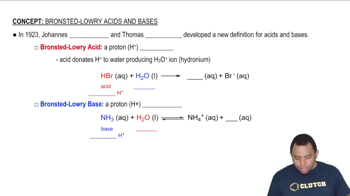
Acid-base theory explains the behavior of substances in terms of their ability to donate protons (H+) or accept protons. According to the Brønsted-Lowry theory, acids are proton donors, while bases are proton acceptors. Understanding this theory is essential for predicting the acidity or basicity of a solution.
Video consigliato:
Percorso guidato
02:08
Bronsted-Lowry Acid-Base Theory

Salt Hydrolysis

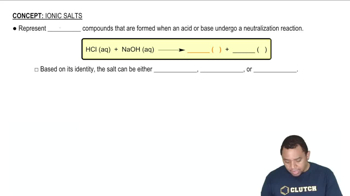
Salt hydrolysis occurs when an ionic compound dissolves in water and its ions interact with water molecules, potentially affecting the pH of the solution. The nature of the ions derived from the salt determines whether the solution will be acidic, basic, or neutral. For example, the hydrolysis of NaBr does not produce H+ or OH- ions, leading to a neutral solution.
Video consigliato:

pH Scale

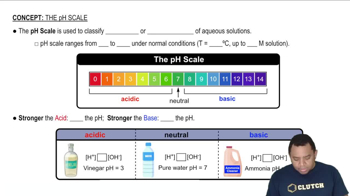
The pH scale measures the acidity or basicity of a solution, ranging from 0 (very acidic) to 14 (very basic), with 7 being neutral. A solution's pH is determined by the concentration of hydrogen ions (H+). Understanding the pH scale is crucial for interpreting the results of acid-base reactions and predicting the behavior of solutions.
Video consigliato: