Predict whether aqueous solutions of the following substances are acidic, basic, or neutral: (a) AlCl3
Ch.16 - Acid-Base Equilibria

Brown15th EditionChemistry: The Central ScienceISBN: 9780137542970Non è quello che usi tu?Cambia libro di testo
Capitolo 16, Problema 86c
Pyridinium bromide 1C5H5NHBr2 is a strong electrolyte that dissociates completely into C5H5NH+ and Br-. An aqueous solution of pyridinium bromide has a pH of 2.95. (c) A solution of pyridinium bromide has a pH of 2.95. What is the concentration of the pyridinium cation at equilibrium, in units of molarity?
Guida verificata passo dopo passo1
Identify that pyridinium bromide (C5H5NHBr) is a strong electrolyte and dissociates completely in water into C5H5NH^+ and Br^- ions.
Recognize that the pH of the solution is given as 2.95, which can be used to find the concentration of hydrogen ions [H^+].
Use the formula for pH: \( \text{pH} = -\log[H^+] \) to calculate the concentration of hydrogen ions [H^+].
Since the solution is acidic due to the presence of C5H5NH^+, assume that the concentration of C5H5NH^+ is equal to the concentration of [H^+] at equilibrium.
Conclude that the concentration of the pyridinium cation (C5H5NH^+) at equilibrium is equal to the concentration of [H^+] calculated from the pH.

Risposta video verificata per un problema simile:
Questa soluzione video è stata consigliata dai nostri tutor come utile per risolvere questo problema.
Durata del video:
6mConcetti chiave
Ecco i concetti essenziali che devi comprendere per rispondere correttamente alla domanda.
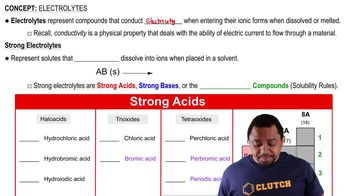
Strong Electrolytes
Strong electrolytes are substances that completely dissociate into ions when dissolved in water. This means that in a solution, they exist entirely as ions, which allows them to conduct electricity efficiently. Pyridinium bromide, as a strong electrolyte, dissociates into pyridinium cations (C5H5NH+) and bromide anions (Br-) in aqueous solution.
Video consigliato:
Percorso guidato
Electrolytes and Strong Acids
pH and Hydrogen Ion Concentration
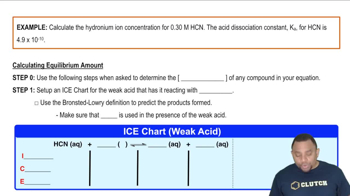
pH is a measure of the acidity or basicity of a solution, defined as the negative logarithm of the hydrogen ion concentration. A pH of 2.95 indicates a relatively high concentration of hydrogen ions (H+) in the solution, which can be calculated using the formula [H+] = 10^(-pH). This relationship is crucial for determining the concentration of the pyridinium cation in the solution.
Video consigliato:
Percorso guidato
Hydronium Ion Concentration Example
Equilibrium Concentration
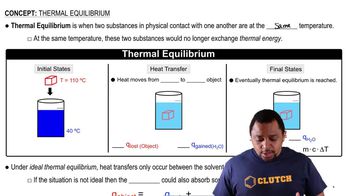
Equilibrium concentration refers to the concentration of reactants and products in a chemical reaction at equilibrium. In this context, since pyridinium bromide dissociates completely, the concentration of the pyridinium cation at equilibrium can be inferred from the pH of the solution. By calculating the hydrogen ion concentration and recognizing the stoichiometry of the dissociation, one can determine the molarity of the pyridinium cation.
Video consigliato:
Percorso guidato
Thermal Equilibrium
Pratica correlata
Domanda del libro di testo
388
views
Domanda del libro di testo
Predict whether aqueous solutions of the following substances are acidic, basic, or neutral: (b) NaBr
851
views
Domanda del libro di testo
Predict whether aqueous solutions of the following compounds are acidic, basic, or neutral: (c) Na2CO3
1047
views
Domanda del libro di testo
Pyridinium bromide 1C5H5NHBr2 is a strong electrolyte that dissociates completely into C5H5NH+ and Br-. An aqueous solution of pyridinium bromide has a pH of 2.95. (b) Using Appendix D, calculate the Ka for pyridinium bromide.
577
views
Domanda del libro di testo
Pyridinium bromide 1C5H5NHBr2 is a strong electrolyte that dissociates completely into C5H5NH+ and Br-. An aqueous solution of pyridinium bromide has a pH of 2.95. (a) Write out the reaction that leads to this acidic pH.
844
views
1
rank