Ch.18 - Chemistry of the Environment
Brown - Chemistry: The Central Science 15th Edition
Brown15th EditionChemistry: The Central ScienceISBN: 9780137542970Non è quello che usi tu?Cambia libro di testo
Capitolo 18, Problema 69d

Write balanced chemical equations for each of the following reactions: (d) Nitrogen dioxide dissolves in water to form nitric acid and nitric oxide.

Guida verificata passo dopo passo
1
Identify the reactants and products in the reaction: Nitrogen dioxide (NO_2) and water (H_2O) are the reactants, while nitric acid (HNO_3) and nitric oxide (NO) are the products.
Write the unbalanced chemical equation using the chemical formulas of the reactants and products: NO_2 + H_2O → HNO_3 + NO.
Balance the equation by adjusting coefficients to ensure the same number of each type of atom on both sides of the equation.
Start by balancing the nitrogen atoms. There are two nitrogen atoms in the reactants (from 2 NO_2), so ensure there are two nitrogen atoms in the products.
Balance the oxygen atoms. Count the total number of oxygen atoms on each side and adjust coefficients as necessary to balance them.

Risposta video verificata per un problema simile:

Questa soluzione video è stata consigliata dai nostri tutor come utile per risolvere questo problema.
Durata del video:
1m

Concetti chiave

Ecco i concetti essenziali che devi comprendere per rispondere correttamente alla domanda.

Chemical Equations

A chemical equation represents a chemical reaction using symbols and formulas. It shows the reactants on the left side and the products on the right, separated by an arrow. Balancing the equation ensures that the number of atoms for each element is the same on both sides, adhering to the law of conservation of mass.
Video consigliato:
Percorso guidato
01:32
Balancing Chemical Equations

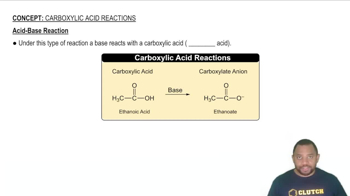
Acid-Base Reactions

Acid-base reactions involve the transfer of protons (H+) between reactants. In this context, nitrogen dioxide (NO2) reacts with water (H2O) to form nitric acid (HNO3), which is an acid, and nitric oxide (NO), which is a neutral product. Understanding the properties of acids and bases is crucial for predicting the products of such reactions.
Video consigliato:
Percorso guidato
01:09
Acid-Base Reaction

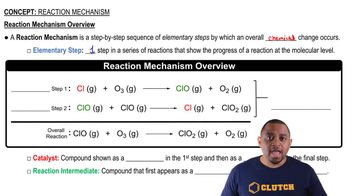
Dissolution and Reaction Mechanisms

Dissolution refers to the process of a solute (like nitrogen dioxide) interacting with a solvent (water) to form a solution. In this case, NO2 reacts with H2O, leading to the formation of HNO3 and NO. Recognizing how gases dissolve in liquids and the subsequent reactions that occur is essential for writing accurate balanced equations.
Video consigliato:
Percorso guidato
03:06
Reaction Mechanism Overview
Pratica correlata
Domanda del libro di testo

(b) Will Mg(OH)2 precipitate when 4.0 g of Na2CO3 is added to 1.00 L of a solution containing 125 ppm of Mg2+?

367
views

Domanda del libro di testo

(a) The EPA threshold for acceptable levels of lead ions in water is 615 ppb. What is the molarity of an aqueous solution with a concentration of 15 ppb?

1
views
Domanda del libro di testo

(b) Concentrations of lead in the bloodstream are often quoted in units of μg/dL. Averaged over the entire country, the mean concentration of lead in the blood was measured to be 1.6 μg/dL in 2008. Express this concentration in ppb.

378
views
Domanda del libro di testo

The solar power striking Earth every day averages 168 watts per square meter. The highest ever recorded electrical power usage in New York City was 13,200 MW. A record established in July of 2013. Considering that present technology for solar energy conversion is about 10% efficient, from how many square meters of land must sunlight be collected in order to provide this peak power? (For compar- ison, the total area of New York City is 830 km2.)

1768
views
Domanda del libro di testo

The rate of solar energy striking Earth averages 168 watts per square meter. The rate of energy radiated from Earth's surface averages 390 watts per square meter. Comparing these numbers, one might expect that the planet would cool quickly, yet it does not. Why not?

1865
views
Domanda del libro di testo

Write balanced chemical equations for each of the following reactions: (a) The nitric oxide molecule undergoes photodissociation in the upper atmosphere. (b) The nitric oxide molecule undergoes photoionization in the upper atmosphere. (c) Nitric oxide undergoes oxidation by ozone in the stratosphere.

396
views