Ch.19 - Chemical Thermodynamics
Brown - Chemistry: The Central Science 15th Edition
Brown15th EditionChemistry: The Central ScienceISBN: 9780137542970Non è quello che usi tu?Cambia libro di testo
Capitolo 19, Problema 49

Ammonium nitrate dissolves spontaneously and endothermally in water at room temperature. What can you deduce about the sign of ΔS for this dissolution process?

Guida verificata passo dopo passo
1
Step 1: Understand the process: Ammonium nitrate dissolving in water is a physical process where the solid ammonium nitrate dissociates into its ions in the aqueous solution.
Step 2: Recognize the nature of the process: The dissolution is spontaneous and endothermic, meaning it absorbs heat from the surroundings.
Step 3: Apply the Gibbs Free Energy equation: The spontaneity of a process is determined by the Gibbs Free Energy change (ΔG), where ΔG = ΔH - TΔS. For a process to be spontaneous, ΔG must be negative.
Step 4: Analyze the terms: Since the process is endothermic, ΔH is positive. For ΔG to be negative (spontaneous process), the TΔS term must be large enough to overcome the positive ΔH.
Step 5: Deduce the sign of ΔS: Since TΔS must be positive and large to make ΔG negative, ΔS (change in entropy) must be positive, indicating an increase in disorder as the solid dissolves into ions.

Concetti chiave

Ecco i concetti essenziali che devi comprendere per rispondere correttamente alla domanda.

Dissolution Process

The dissolution process involves a solute (in this case, ammonium nitrate) interacting with a solvent (water) to form a solution. This process can be influenced by temperature, pressure, and the nature of the solute and solvent. Understanding how solutes dissolve helps in predicting the thermodynamic behavior of solutions.
Video consigliato:
Percorso guidato
04:20
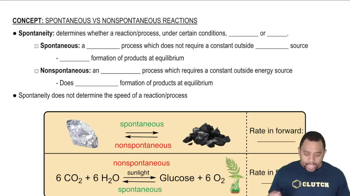
Spontaneity of Processes

Enthalpy Change (ΔH)

Enthalpy change (ΔH) refers to the heat absorbed or released during a chemical process at constant pressure. In the case of ammonium nitrate, the dissolution is described as endothermic, meaning it absorbs heat from the surroundings. This characteristic influences the overall energy balance of the dissolution process and is crucial for understanding the thermodynamic favorability.
Video consigliato:
Percorso guidato
02:34
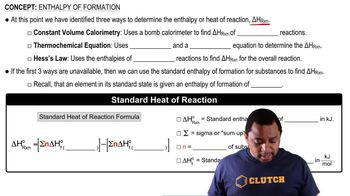
Enthalpy of Formation

Entropy Change (ΔS)

Entropy change (ΔS) is a measure of the disorder or randomness in a system. A positive ΔS indicates an increase in disorder, while a negative ΔS suggests a decrease. In the context of ammonium nitrate dissolving in water, the spontaneous nature of the process implies that despite being endothermic, the increase in disorder from solute particles dispersing in the solvent leads to a positive ΔS.
Video consigliato:
Percorso guidato
01:46
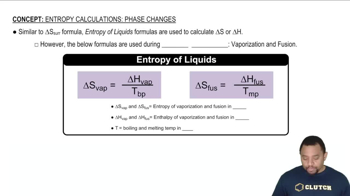
Entropy in Phase Changes