
Ch.9 - Molecular Geometry and Bonding Theories
Brown - Chemistry: The Central Science 15th Edition
Brown15th EditionChemistry: The Central ScienceISBN: 9780137542970Non è quello che usi tu?Cambia libro di testo
Capitolo 9, Problema 77

Determine whether each of the following statements about diamagnetism and paramagnetism is true or false:
a. A diamagnetic substance is weakly repelled from a magnetic field.
b. A substance with unpaired electrons will be diamagnetic.
c. A paramagnetic substance is attracted to a magnetic field.
d. The O2 molecule is paramagnetic.

Guida verificata passo dopo passo
1
insert step 1> Understand the definitions: Diamagnetism refers to substances that are weakly repelled by a magnetic field, while paramagnetism refers to substances that are attracted to a magnetic field due to the presence of unpaired electrons.
insert step 2> Analyze statement a: A diamagnetic substance is weakly repelled from a magnetic field. Based on the definition of diamagnetism, this statement is true.
insert step 3> Analyze statement b: A substance with unpaired electrons will be diamagnetic. Since unpaired electrons cause paramagnetism, this statement is false.
insert step 4> Analyze statement c: A paramagnetic substance is attracted to a magnetic field. Based on the definition of paramagnetism, this statement is true.
insert step 5> Analyze statement d: The O2 molecule is paramagnetic. Consider the molecular orbital theory, which shows that O2 has unpaired electrons, making it paramagnetic. Therefore, this statement is true.

Risposta video verificata per un problema simile:

Questa soluzione video è stata consigliata dai nostri tutor come utile per risolvere questo problema.
Durata del video:
3m

Concetti chiave

Ecco i concetti essenziali che devi comprendere per rispondere correttamente alla domanda.

Diamagnetism

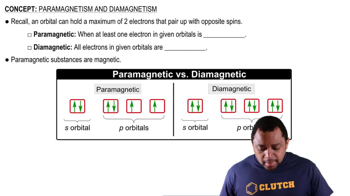
Diamagnetism is a property of materials that are weakly repelled by a magnetic field. This occurs due to the paired electrons in the atoms of the material, which create a small magnetic field in the opposite direction when exposed to an external magnetic field. As a result, diamagnetic substances do not retain any magnetization in the absence of an external field.
Video consigliato:
Percorso guidato
01:33
Paramagnetism and Diamagnetism

Paramagnetism

Paramagnetism is a phenomenon exhibited by materials that have unpaired electrons, leading to a net magnetic moment. These unpaired electrons align with an external magnetic field, causing the material to be attracted to the field. Unlike diamagnetic materials, paramagnetic substances can retain some magnetization even after the external field is removed, although this effect is temporary.
Video consigliato:
Percorso guidato
01:33
Paramagnetism and Diamagnetism

Electron Configuration and Magnetism

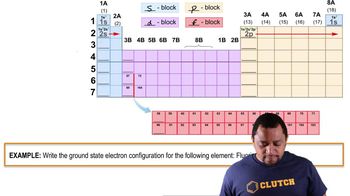
The electron configuration of an atom determines its magnetic properties. Atoms with all electrons paired exhibit diamagnetism, while those with unpaired electrons exhibit paramagnetism. Understanding the arrangement of electrons in an atom, particularly in transition metals and molecules like O2, is crucial for predicting their magnetic behavior in the presence of a magnetic field.
Video consigliato:
Percorso guidato
01:33
Electron Configuration Example
Pratica correlata
Domanda del libro di testo

Using Figures 9.39 and 9.43 as guides, draw the molecular-orbital electron configuration for (d) Ne22+. In each case indicate whether the addition of an electron to the ion would increase or decrease the bond order of the species.

2
views
Domanda del libro di testo

If we assume that the energy-level diagrams for homonuclear diatomic molecules shown in Figure 9.43 can be applied to heteronuclear diatomic molecules and ions, predict the bond order and magnetic behavior of b. NO–

2
views
Domanda del libro di testo

a. Based on its molecular-orbital diagram, what is the bond order of the O2 molecule?

b. What is the expected bond order for the peroxide ion, O22−?

c. What is the expected bond order for the superoxide ion, O2−?

d. From shortest to longest, predict the ordering of the bond lengths for O2, O22−, and O2−.

e. From weakest to strongest, predict the ordering of the bond strengths for O2, O22−, and O2−.

Domanda del libro di testo

a. Which of the following is expected to be paramagnetic: Ne, Li2, Li2+, N2, N2+, N22−? b. For each of the substances in part (a) that is paramagnetic, determine the number of unpaired electrons it has.

3
views
Domanda del libro di testo

Indicate whether each statement is true or false. (d) Electrons cannot occupy a nonbonding orbital.

314
views
Domanda del libro di testo

Indicate whether each statement is true or false. c. Antibonding orbitals are higher in energy than bonding orbitals (if all orbitals are created from the same atomic orbitals).

5
views