Ch.9 - Molecular Geometry and Bonding Theories
Brown - Chemistry: The Central Science 15th Edition
Brown15th EditionChemistry: The Central ScienceISBN: 9780137542970Non è quello che usi tu?Cambia libro di testo
Capitolo 9, Problema 73c

Draw a picture that shows all three 2p orbitals on one atom and all three 2p orbitals on another atom. (c) How many antibonding orbitals, and of what type can be made from the two sets of 2p orbitals?

Guida verificata passo dopo passo
1
Step 1: To draw the 2p orbitals, you need to remember that p orbitals are dumbbell-shaped and there are three of them, each oriented along a different axis (x, y, and z). Draw two atoms, each with three 2p orbitals. The orbitals should be perpendicular to each other, representing the three different axes.
Step 2: Label the orbitals as 2px, 2py, and 2pz for each atom. The labels represent the axes along which the orbitals are oriented.
Step 3: To determine the number of antibonding orbitals, remember that when two atomic orbitals combine, they form a bonding orbital and an antibonding orbital. Therefore, the six 2p orbitals from the two atoms can form three bonding orbitals and three antibonding orbitals.
Step 4: The type of antibonding orbitals formed depends on the orientation of the combining orbitals. When 2px orbitals combine, they form a sigma* (σ*) antibonding orbital. When 2py and 2pz orbitals combine, they form two pi* (π*) antibonding orbitals.
Step 5: So, from the two sets of 2p orbitals, you can form three antibonding orbitals: one sigma* (σ*) and two pi* (π*) orbitals.

Risposta video verificata per un problema simile:

Questa soluzione video è stata consigliata dai nostri tutor come utile per risolvere questo problema.
Durata del video:
3m

Concetti chiave

Ecco i concetti essenziali che devi comprendere per rispondere correttamente alla domanda.

Atomic Orbitals

Atomic orbitals are regions in an atom where there is a high probability of finding electrons. The 2p orbitals are a set of three degenerate orbitals (2px, 2py, 2pz) that can hold a maximum of six electrons. Understanding the shape and orientation of these orbitals is crucial for visualizing how they interact during bonding.
Video consigliato:
Percorso guidato
01:51
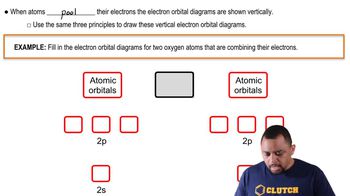
Atomic Orbitals Example

Bonding and Antibonding Orbitals

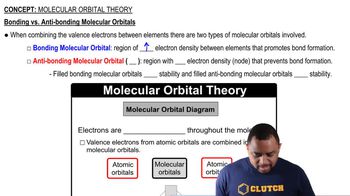
When atomic orbitals combine, they can form bonding and antibonding molecular orbitals. Bonding orbitals result from the constructive interference of wave functions, leading to increased electron density between nuclei, while antibonding orbitals arise from destructive interference, resulting in a node between the nuclei. The type of bonding or antibonding orbital formed depends on the symmetry and orientation of the combining orbitals.
Video consigliato:
Percorso guidato
03:06
Molecular Orbital Theory

Molecular Orbital Theory

Molecular Orbital Theory describes how atomic orbitals combine to form molecular orbitals that can be occupied by electrons. In the case of two sets of 2p orbitals from different atoms, the combination can yield bonding and antibonding orbitals. Specifically, from the three 2p orbitals of each atom, a total of six molecular orbitals can be formed, including three bonding and three antibonding orbitals.
Video consigliato:
Percorso guidato
03:06
Molecular Orbital Theory