Ch.9 - Molecular Geometry and Bonding Theories
Brown - Chemistry: The Central Science 15th Edition
Brown15th EditionChemistry: The Central ScienceISBN: 9780137542970Non è quello che usi tu?Cambia libro di testo
Capitolo 9, Problema 74d

Indicate whether each statement is true or false. (d) Electrons cannot occupy a nonbonding orbital.

Guida verificata passo dopo passo
1
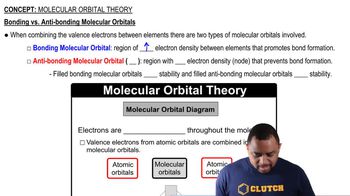
Understand the concept of molecular orbitals: Molecular orbitals are formed by the combination of atomic orbitals when atoms bond together. These orbitals can be bonding, antibonding, or nonbonding.
Define nonbonding orbitals: Nonbonding orbitals are molecular orbitals that are not involved in bonding. They are typically associated with lone pairs of electrons on an atom.
Consider the occupancy of nonbonding orbitals: Electrons can occupy nonbonding orbitals, as these orbitals are often filled with lone pair electrons that do not participate in bonding.
Evaluate the statement: The statement 'Electrons cannot occupy a nonbonding orbital' is incorrect because nonbonding orbitals can indeed be occupied by electrons.
Conclude the analysis: Based on the understanding of nonbonding orbitals and electron occupancy, the statement is false.

Risposta video verificata per un problema simile:

Questa soluzione video è stata consigliata dai nostri tutor come utile per risolvere questo problema.
Durata del video:
1m

Concetti chiave

Ecco i concetti essenziali che devi comprendere per rispondere correttamente alla domanda.

Nonbonding Orbitals

Nonbonding orbitals are molecular orbitals that do not participate in bonding between atoms. They are typically filled with electrons that are localized on a single atom and do not contribute to the overall stability of the molecule through bonding interactions. Understanding the nature of these orbitals is crucial for determining the electronic structure of molecules.
Video consigliato:
Percorso guidato
03:06
Molecular Orbital Theory

Electron Configuration

Electron configuration refers to the distribution of electrons in an atom's orbitals. Each orbital can hold a specific number of electrons, and the arrangement of these electrons determines the chemical properties of the element. In the context of nonbonding orbitals, it is important to recognize that electrons can occupy these orbitals, which influences molecular geometry and reactivity.
Video consigliato:
Percorso guidato
01:33
Electron Configuration Example

Molecular Orbital Theory

Molecular Orbital Theory describes the behavior of electrons in molecules by considering the combination of atomic orbitals to form molecular orbitals. These orbitals can be bonding, antibonding, or nonbonding. This theory helps explain the stability and properties of molecules, including the role of nonbonding orbitals in influencing molecular shape and electron distribution.
Video consigliato:
Percorso guidato
03:06
Molecular Orbital Theory
Pratica correlata
Domanda del libro di testo

Draw a picture that shows all three 2p orbitals on one atom and all three 2p orbitals on another atom. (c) How many antibonding orbitals, and of what type can be made from the two sets of 2p orbitals?

1357
views

Domanda del libro di testo

a. Based on its molecular-orbital diagram, what is the bond order of the O2 molecule?

b. What is the expected bond order for the peroxide ion, O22−?

c. What is the expected bond order for the superoxide ion, O2−?

d. From shortest to longest, predict the ordering of the bond lengths for O2, O22−, and O2−.

e. From weakest to strongest, predict the ordering of the bond strengths for O2, O22−, and O2−.

Domanda del libro di testo

a. Which of the following is expected to be paramagnetic: Ne, Li2, Li2+, N2, N2+, N22−? b. For each of the substances in part (a) that is paramagnetic, determine the number of unpaired electrons it has.

3
views
Domanda del libro di testo

Determine whether each of the following statements about diamagnetism and paramagnetism is true or false:

a. A diamagnetic substance is weakly repelled from a magnetic field.

b. A substance with unpaired electrons will be diamagnetic.

c. A paramagnetic substance is attracted to a magnetic field.

d. The O2 molecule is paramagnetic.

Domanda del libro di testo

Indicate whether each statement is true or false. c. Antibonding orbitals are higher in energy than bonding orbitals (if all orbitals are created from the same atomic orbitals).

5
views
Domanda del libro di testo

Draw a picture that shows all three 2p orbitals on one atom and all three 2p orbitals on another atom. (b) How many p bonds can the two sets of 2p orbitals make with each other?

642
views