Ch.9 - Molecular Geometry and Bonding Theories
Brown - Chemistry: The Central Science 15th Edition
Brown15th EditionChemistry: The Central ScienceISBN: 9780137542970Non è quello che usi tu?Cambia libro di testo
Capitolo 9, Problema 74c

Indicate whether each statement is true or false. c. Antibonding orbitals are higher in energy than bonding orbitals (if all orbitals are created from the same atomic orbitals).

Guida verificata passo dopo passo
1
Understand the concept of molecular orbitals: When atomic orbitals combine, they form molecular orbitals, which can be either bonding or antibonding.
Recognize that bonding orbitals are formed by the constructive interference of atomic orbitals, leading to a lower energy state.
Antibonding orbitals result from the destructive interference of atomic orbitals, which increases the energy of the system.
Compare the energy levels: Bonding orbitals are lower in energy because they stabilize the molecule, while antibonding orbitals are higher in energy because they destabilize the molecule.
Conclude that the statement is true: Antibonding orbitals are indeed higher in energy than bonding orbitals when formed from the same atomic orbitals.

Risposta video verificata per un problema simile:

Questa soluzione video è stata consigliata dai nostri tutor come utile per risolvere questo problema.
Durata del video:
2m

Concetti chiave

Ecco i concetti essenziali che devi comprendere per rispondere correttamente alla domanda.

Bonding and Antibonding Orbitals

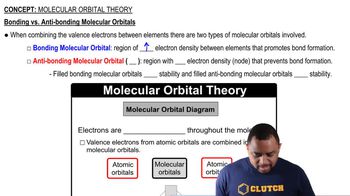
Bonding orbitals are formed when atomic orbitals combine constructively, leading to increased electron density between nuclei, which stabilizes the molecule. In contrast, antibonding orbitals result from destructive interference of atomic orbitals, creating a node between the nuclei and leading to higher energy states. This fundamental distinction is crucial for understanding molecular stability.
Video consigliato:
Percorso guidato
03:06
Molecular Orbital Theory

Energy Levels of Molecular Orbitals

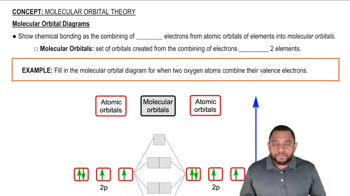
In molecular orbital theory, the energy levels of molecular orbitals are determined by the nature of the atomic orbitals that combine. Generally, bonding orbitals are lower in energy than the original atomic orbitals, while antibonding orbitals are higher in energy. This energy hierarchy is essential for predicting the stability and reactivity of molecules.
Video consigliato:
Percorso guidato
04:12
Molecular Orbital Diagram

Molecular Orbital Theory

Molecular orbital theory describes the behavior of electrons in molecules by considering the combination of atomic orbitals to form molecular orbitals. This theory provides insights into the electronic structure of molecules, including the distribution of electrons in bonding and antibonding orbitals, which directly influences molecular properties and reactivity.
Video consigliato:
Percorso guidato
03:06
Molecular Orbital Theory