Ch.9 - Molecular Geometry and Bonding Theories
Brown - Chemistry: The Central Science 15th Edition
Brown15th EditionChemistry: The Central ScienceISBN: 9780137542970Non è quello che usi tu?Cambia libro di testo
Capitolo 9, Problema 10a

The following is part of a molecular orbital energy-level diagram for MOs constructed from 1s atomic orbitals.
Molecular orbital energy-level diagram showing two molecular orbitals from 1s atomic orbitals.
(a) What labels do we use for the two MOs shown?

Guida verificata passo dopo passo
1
Identify the atomic orbitals involved in the formation of molecular orbitals. In this case, the diagram shows molecular orbitals formed from 1s atomic orbitals.
Recognize that the two molecular orbitals formed from 1s atomic orbitals are the bonding and antibonding molecular orbitals.
Label the lower energy molecular orbital as the bonding molecular orbital, denoted as σ(1s).
Label the higher energy molecular orbital as the antibonding molecular orbital, denoted as σ*(1s).
Note that the bonding molecular orbital (σ(1s)) is lower in energy and more stable, while the antibonding molecular orbital (σ*(1s)) is higher in energy and less stable.

Risposta video verificata per un problema simile:

Questa soluzione video è stata consigliata dai nostri tutor come utile per risolvere questo problema.
Durata del video:
1m

Concetti chiave

Ecco i concetti essenziali che devi comprendere per rispondere correttamente alla domanda.

Molecular Orbitals (MOs)

Molecular orbitals are formed by the linear combination of atomic orbitals (LCAO) when atoms bond. In the case of diatomic molecules, the 1s atomic orbitals from each atom combine to create two types of molecular orbitals: bonding and antibonding. The bonding molecular orbital is lower in energy and stabilizes the molecule, while the antibonding molecular orbital is higher in energy and can destabilize it.
Video consigliato:
Percorso guidato
03:06
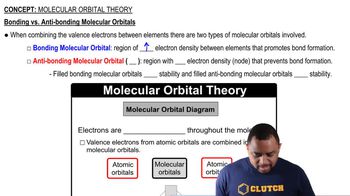
Molecular Orbital Theory

Bonding and Antibonding Orbitals

Bonding orbitals are formed when atomic orbitals combine constructively, leading to increased electron density between the nuclei, which stabilizes the molecule. Antibonding orbitals, on the other hand, result from destructive interference, creating a node between the nuclei and leading to decreased electron density in that region, which can destabilize the molecule. The labels for these orbitals are typically denoted as σ (sigma) for bonding and σ* (sigma star) for antibonding.
Video consigliato:
Percorso guidato
03:06
Molecular Orbital Theory

Energy-Level Diagrams

Energy-level diagrams visually represent the relative energies of molecular orbitals. In these diagrams, bonding orbitals are placed lower in energy than their corresponding antibonding orbitals. The arrangement helps predict the stability of the molecule based on the number of electrons in each type of orbital, guiding the understanding of molecular structure and reactivity.
Video consigliato:
Percorso guidato
01:57
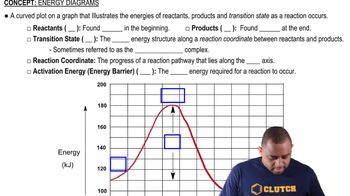
Energy Diagrams
Pratica correlata
Domanda del libro di testo

For each of these contour representations of molecular orbitals, identify (b) the type of MO (s or p) (iii)

284
views

Domanda del libro di testo

For each of these contour representations of molecular orbitals, identify (a) the atomic orbitals (s or p) used to construct the MO (iii)

375
views
Domanda del libro di testo

For each of these contour representations of molecular orbitals, identify (a) the atomic orbitals (s or p) used to construct the MO (i)

551
views
Domanda del libro di testo

The drawing below shows the overlap of two hybrid orbitals to form a bond in a hydrocarbon. (a) Which of the following types of bonds is being formed: (i) C¬C s, (ii) C¬C p, or (iii) C¬H s?

464
views
Domanda del libro di testo

The drawing below shows the overlap of two hybrid orbitals to form a bond in a hydrocarbon. (b) Which of the following could be the identity of the hydrocarbon: (i) CH4, (ii) C2H6, (iii) C2H4, or (iv) C2H2?

763
views
Domanda del libro di testo

The molecule shown here is called furan. It is represented in the typical shorthand way for organic molecules, with hydrogen atoms not shown, and each of the four vertices representing a carbon atom. e. The bond angles in furan are much smaller than those in benzene. The likely reason is which of the following? i. The hybridization of the carbon atoms in furan is different from that in benzene. ii. Furan does not have another resonance structure equivalent to the one shown here. iii. The atoms are forced to adopt smaller angles in a five-membered ring than in a six-membered ring. [Section 9.5]