Ch.9 - Molecular Geometry and Bonding Theories
Brown - Chemistry: The Central Science 15th Edition
Brown15th EditionChemistry: The Central ScienceISBN: 9780137542970Non è quello che usi tu?Cambia libro di testo
Capitolo 9, Problema 9e

The molecule shown here is called furan. It is represented in the typical shorthand way for organic molecules, with hydrogen atoms not shown, and each of the four vertices representing a carbon atom. e. The bond angles in furan are much smaller than those in benzene. The likely reason is which of the following? i. The hybridization of the carbon atoms in furan is different from that in benzene. ii. Furan does not have another resonance structure equivalent to the one shown here. iii. The atoms are forced to adopt smaller angles in a five-membered ring than in a six-membered ring. [Section 9.5]

Guida verificata passo dopo passo
1
insert step 1> Identify the structure of furan and benzene. Furan is a five-membered ring with one oxygen atom, while benzene is a six-membered carbon ring.
insert step 2> Consider the hybridization of the carbon atoms. In benzene, the carbon atoms are sp2 hybridized, leading to bond angles of approximately 120 degrees.
insert step 3> Analyze the hybridization in furan. The carbon atoms in furan are also sp2 hybridized, but the presence of the oxygen atom and the five-membered ring structure affects the bond angles.
insert step 4> Evaluate the resonance structures. Benzene has equivalent resonance structures that contribute to its stability and bond angles, while furan's resonance structures are not equivalent, affecting its bond angles.
insert step 5> Consider the ring size. A five-membered ring like furan naturally has smaller bond angles compared to a six-membered ring like benzene due to geometric constraints.

Risposta video verificata per un problema simile:

Questa soluzione video è stata consigliata dai nostri tutor come utile per risolvere questo problema.
Durata del video:
3m

Concetti chiave

Ecco i concetti essenziali che devi comprendere per rispondere correttamente alla domanda.

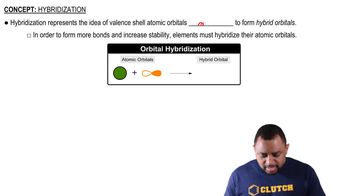
Hybridization

Hybridization is the concept in chemistry that describes the mixing of atomic orbitals to form new hybrid orbitals, which can explain the geometry of molecular bonding. In furan, the carbon atoms are sp2 hybridized, allowing for a planar structure with bond angles around 120 degrees. In contrast, benzene's carbon atoms are also sp2 hybridized, but the presence of resonance allows for a more stable, symmetrical arrangement with bond angles of 120 degrees as well.
Video consigliato:

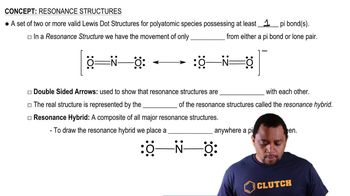
Resonance Structures

Resonance structures are different ways of drawing a molecule that represent the same compound, highlighting the delocalization of electrons. In benzene, multiple resonance structures contribute to its stability and equal bond lengths, while furan has fewer resonance structures, which can affect its bond angles and overall stability. The presence or absence of resonance can significantly influence molecular geometry and reactivity.
Video consigliato:
Percorso guidato
01:42
Resonance Structures

Ring Strain

Ring strain refers to the increased energy and instability that occurs in cyclic compounds due to bond angles deviating from their ideal values. In five-membered rings like furan, the bond angles are typically smaller than the ideal tetrahedral angle of 109.5 degrees, leading to strain. This contrasts with six-membered rings like benzene, which can maintain ideal bond angles due to their resonance stabilization, resulting in less strain and more favorable geometry.
Video consigliato:
Percorso guidato
01:21
Chelating Agents