Ch.10 - Gases: Their Properties & Behavior
McMurry - Chemistry 8th Edition
McMurry8th EditionChemistryISBN: 9781292336145Non è quello che usi tu?Cambia libro di testo
Capitolo 10, Problema 92

What are the basic assumptions of the kinetic–molecular theory?

Guida verificata passo dopo passo
1
The kinetic-molecular theory is a model that helps explain the behavior of gases. It is based on several key assumptions about the nature of gas particles.
Assumption 1: Gas particles are in constant, random motion. They move in straight lines until they collide with either the container walls or other particles.
Assumption 2: The volume of the individual gas particles is negligible compared to the volume of the container. This means that the particles themselves take up very little space.
Assumption 3: There are no attractive or repulsive forces between the gas particles. They do not interact with each other except during collisions.
Assumption 4: Collisions between gas particles and with the walls of the container are perfectly elastic. This means that there is no net loss of kinetic energy during these collisions.

Risposta video verificata per un problema simile:

Questa soluzione video è stata consigliata dai nostri tutor come utile per risolvere questo problema.
Durata del video:
2m

Concetti chiave

Ecco i concetti essenziali che devi comprendere per rispondere correttamente alla domanda.

Kinetic-Molecular Theory

The kinetic-molecular theory explains the behavior of gases based on the idea that gas particles are in constant, random motion. It posits that the temperature of a gas is directly related to the average kinetic energy of its particles, which helps to describe how gases expand, compress, and exert pressure.
Video consigliato:
Percorso guidato
01:19
Kinetic Molecular Theory

Assumptions of Ideal Gases

The kinetic-molecular theory is built on several key assumptions about ideal gases: gas particles are considered to have negligible volume, they do not attract or repel each other, and they collide elastically, meaning that energy is conserved in collisions. These assumptions simplify the complex interactions in real gases, allowing for easier calculations and predictions.
Video consigliato:
Percorso guidato
01:15
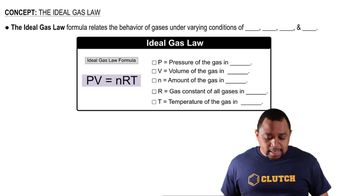
Ideal Gas Law Formula

Pressure and Temperature Relationship

According to the kinetic-molecular theory, pressure is a result of collisions between gas particles and the walls of their container. As temperature increases, the kinetic energy of the particles increases, leading to more frequent and forceful collisions, which in turn raises the pressure. This relationship is fundamental in understanding gas behavior under varying conditions.
Video consigliato:
Percorso guidato
01:08
Standard Temperature and Pressure