Ch.10 - Gases: Their Properties & Behavior
McMurry - Chemistry 8th Edition
McMurry8th EditionChemistryISBN: 9781292336145Non è quello che usi tu?Cambia libro di testo
Capitolo 10, Problema 91b

Gaseous compound Q contains only xenon and oxygen. When 0.100 g of Q is placed in a 50.0-mL steel vessel at 0 °C the pressure is 0.229 atm. (b) When the vessel and its contents are warmed to 100 °C, Q decomposes into its constituent elements. What is the total pressure, and what are the partial pressures of xenon and oxygen in the container?

Guida verificata passo dopo passo
1
Determine the initial number of moles of compound Q using the ideal gas law equation: PV = nRT. Here, P is the initial pressure, V is the volume of the container, R is the ideal gas constant (0.0821 L atm K^{-1} mol^{-1}), and T is the initial temperature in Kelvin.
Convert the initial temperature from Celsius to Kelvin by adding 273.15 to the Celsius temperature.
Calculate the final temperature in Kelvin by converting 100 °C to Kelvin.
Assume complete decomposition of compound Q into xenon and oxygen. Since the number of moles of gas increases due to decomposition, use stoichiometry based on the chemical formula of Q to determine the ratio in which xenon and oxygen are formed.
Calculate the total pressure at the new temperature using the ideal gas law, considering the total number of moles of xenon and oxygen. Then, use the mole fraction of each gas to find their respective partial pressures.

Risposta video verificata per un problema simile:

Questa soluzione video è stata consigliata dai nostri tutor come utile per risolvere questo problema.
Durata del video:
11m

Concetti chiave

Ecco i concetti essenziali che devi comprendere per rispondere correttamente alla domanda.

Ideal Gas Law

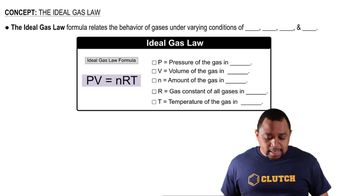
The Ideal Gas Law relates the pressure, volume, temperature, and number of moles of a gas through the equation PV = nRT. This law is essential for calculating the behavior of gases under varying conditions, such as changes in temperature and pressure, which is crucial for solving the problem involving the gaseous compound Q.
Video consigliato:
Percorso guidato
01:15
Ideal Gas Law Formula

Decomposition Reactions

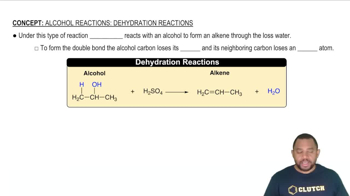
Decomposition reactions involve the breakdown of a compound into its constituent elements or simpler compounds. In this scenario, understanding how compound Q decomposes into xenon and oxygen at elevated temperatures is vital for determining the resulting pressures of each gas in the vessel after the reaction occurs.
Video consigliato:
Percorso guidato
01:30
Alcohol Reactions: Dehydration Reactions

Dalton's Law of Partial Pressures

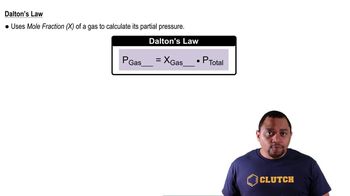
Dalton's Law states that in a mixture of non-reacting gases, the total pressure exerted is equal to the sum of the partial pressures of each individual gas. This principle is key to calculating the total pressure and the partial pressures of xenon and oxygen after the decomposition of compound Q in the steel vessel.
Video consigliato:
Percorso guidato
00:27
Dalton's Law and Partial Pressure