Ch.10 - Gases: Their Properties & Behavior
McMurry - Chemistry 8th Edition
McMurry8th EditionChemistryISBN: 9781292336145Non è quello che usi tu?Cambia libro di testo
Capitolo 10, Problema 91a

Gaseous compound Q contains only xenon and oxygen. When 0.100 g of Q is placed in a 50.0-mL steel vessel at 0 °C the pressure is 0.229 atm. (a) What is the molar mass of Q, and what is a likely formula?

Guida verificata passo dopo passo
1
Determine the number of moles of compound Q using the ideal gas law equation: PV = nRT. Here, P is the pressure, V is the volume, n is the number of moles, R is the gas constant (0.0821 L atm K^{-1} mol^{-1}), and T is the temperature in Kelvin.
Convert the temperature from Celsius to Kelvin by adding 273.15 to the Celsius temperature.
Substitute the values of P, V, and T into the ideal gas law equation to solve for n, the number of moles of Q.
Calculate the molar mass of compound Q by dividing the mass of the sample (in grams) by the number of moles calculated in the previous step.
Based on the molar mass and the fact that the compound contains only xenon (Xe) and oxygen (O), propose possible molecular formulas by combining xenon and oxygen in ratios that yield a molar mass close to the calculated value. Common combinations to consider include XeO, XeO2, XeO3, and XeO4.

Risposta video verificata per un problema simile:

Questa soluzione video è stata consigliata dai nostri tutor come utile per risolvere questo problema.
Durata del video:
5m

Concetti chiave

Ecco i concetti essenziali che devi comprendere per rispondere correttamente alla domanda.

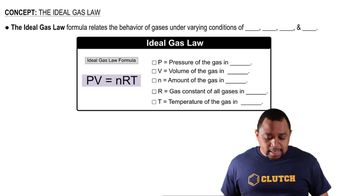
Ideal Gas Law

The Ideal Gas Law relates the pressure, volume, temperature, and number of moles of a gas through the equation PV = nRT. In this context, it allows us to calculate the number of moles of the gaseous compound Q using the given pressure, volume, and temperature, which is essential for determining its molar mass.
Video consigliato:
Percorso guidato
01:15
Ideal Gas Law Formula

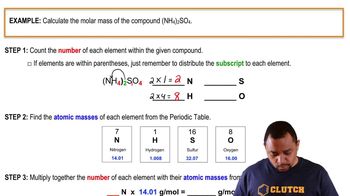
Molar Mass Calculation

Molar mass is defined as the mass of one mole of a substance, typically expressed in grams per mole (g/mol). To find the molar mass of compound Q, we can use the mass of the sample and the number of moles calculated from the Ideal Gas Law, allowing us to identify the compound's formula based on its elemental composition.
Video consigliato:
Percorso guidato
03:12
Molar Mass Calculation Example

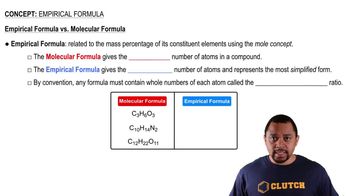
Empirical and Molecular Formulas

The empirical formula represents the simplest whole-number ratio of elements in a compound, while the molecular formula indicates the actual number of atoms of each element in a molecule. By determining the molar mass and the ratio of xenon to oxygen in compound Q, we can deduce a likely molecular formula that corresponds to the calculated molar mass.
Video consigliato:
Percorso guidato
02:26
Empirical vs Molecular Formula
Pratica correlata
Domanda del libro di testo
What are the basic assumptions of the kinetic–molecular theory?
903
views

Domanda del libro di testo

Natural gas is a mixture of hydrocarbons, primarily methane 1CH42 and ethane 1C2H62. A typical mixture might have Xmethane = 0.915 and Xethane = 0.085. Let's assume that we have a 15.50 g sample of natural gas in a volume of 15.00 L at a temperature of 20.00 °C. (a) How many total moles of gas are in the sample?

464
views
Domanda del libro di testo

What is the difference between heat and temperature?

459
views
Domanda del libro di testo

Natural gas is a mixture of hydrocarbons, primarily methane (CH4) and ethane (C2H6). A typical mixture might have Xmethane = 0.915 and Xethane = 0.085. Let's assume that we have a 15.50 g sample of natural gas in a volume of 15.00 L at a temperature of 20.00 °C. (c) What is the partial pressure of each component in the sample in atmospheres?

541
views
Domanda del libro di testo

Natural gas is a mixture of hydrocarbons, primarily methane (CH4) and ethane (C2H6). A typical mixture might have Xmethane = 0.915 and Xethane = 0.085. Let's assume that we have a 15.50 g sample of natural gas in a volume of 15.00 L at a temperature of 20.00 °C. (b) What is the pressure of the sample in atmospheres?

1359
views
Domanda del libro di testo

Gaseous compound Q contains only xenon and oxygen. When 0.100 g of Q is placed in a 50.0-mL steel vessel at 0 °C the pressure is 0.229 atm. (b) When the vessel and its contents are warmed to 100 °C, Q decomposes into its constituent elements. What is the total pressure, and what are the partial pressures of xenon and oxygen in the container?

468
views