
Ch.10 - Gases: Their Properties & Behavior
McMurry - Chemistry 8th Edition
McMurry8th EditionChemistryISBN: 9781292336145Non è quello che usi tu?Cambia libro di testo
Capitolo 10, Problema 7

Trimix is a gas mixture consisting of oxygen, helium, and nitrogen used for deep scuba dives. The helium is included to reduce the effects of nitrogen narcosis and oxygen toxicity that occur when too much nitrogen and oxygen dissolve in the blood. A tank of Trimix has a total pressure of 200 atm, and the partial pressure of He is 34 atm. What is the percent by volume of He in the tank? (LO 10.7) (a) 17% (b) 38% (c) 23% (d) 83%

Guida verificata passo dopo passo
1
Identify the total pressure of the gas mixture in the tank, which is given as 200 atm.
Identify the partial pressure of helium (He) in the mixture, which is given as 34 atm.
Use the formula for calculating the mole fraction of a gas in a mixture: \( \text{Mole fraction of He} = \frac{\text{Partial pressure of He}}{\text{Total pressure}} \).
Convert the mole fraction to percent by multiplying by 100 to find the percent by volume of He in the tank.
Compare the calculated percent by volume of He with the provided options to find the correct answer.

Risposta video verificata per un problema simile:

Questa soluzione video è stata consigliata dai nostri tutor come utile per risolvere questo problema.
Durata del video:
3m

Concetti chiave

Ecco i concetti essenziali che devi comprendere per rispondere correttamente alla domanda.

Partial Pressure

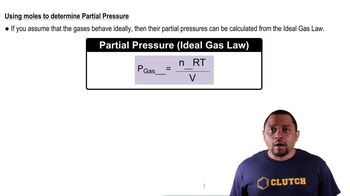
Partial pressure refers to the pressure exerted by a single component of a gas mixture. According to Dalton's Law of Partial Pressures, the total pressure of a gas mixture is the sum of the partial pressures of each individual gas. In this context, understanding how to calculate the partial pressure of helium relative to the total pressure is essential for determining its volume percentage in the Trimix mixture.
Video consigliato:
Percorso guidato
00:48
Partial Pressure Calculation

Volume Percent

Volume percent is a way of expressing the concentration of a component in a mixture, defined as the volume of the component divided by the total volume of the mixture, multiplied by 100. In the case of gases, this can also be related to partial pressures, as the volume percent of a gas in a mixture is directly proportional to its partial pressure when the temperature and total pressure are constant.
Video consigliato:
Percorso guidato
02:35
Constant-Volume Calorimetry

Gas Laws

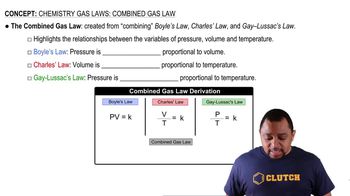
Gas laws describe the behavior of gases under various conditions of pressure, volume, and temperature. The Ideal Gas Law (PV=nRT) is particularly relevant here, as it relates the pressure, volume, and temperature of a gas. Understanding these laws helps in calculating the relationships between the components of gas mixtures, such as how the partial pressures contribute to the overall behavior of the gas mixture in the tank.
Video consigliato:
Percorso guidato
01:43
Combined Gas Law