What is the molecular weight of a gas that diffuses through
a porous membrane 1.86 times faster than Xe? What might
the gas be?
Guida verificata passo dopo passo
1
1. The rate of diffusion of a gas is inversely proportional to the square root of its molar mass. This is known as Graham's law of diffusion. Mathematically, it can be expressed as: \(\frac{r_1}{r_2} = \sqrt{\frac{M_2}{M_1}}\), where \(r_1\) and \(r_2\) are the rates of diffusion of the two gases, and \(M_1\) and \(M_2\) are their respective molar masses.
2. In this problem, we know that the unknown gas diffuses 1.86 times faster than Xe. So, \(\frac{r_1}{r_2} = 1.86\). We also know the molar mass of Xe, which is 131.29 g/mol. We can denote this as \(M_2\).
3. We can rearrange Graham's law to solve for the molar mass of the unknown gas (\(M_1\)): \(M_1 = \frac{M_2}{(\frac{r_1}{r_2})^2}\).
4. Substitute the known values into the equation to find the molar mass of the unknown gas.
5. Once you have the molar mass, you can compare it to the molar masses of known gases to identify the unknown gas. The gas with a molar mass closest to your calculated value is likely the unknown gas.
Risposta video verificata per un problema simile:
Questa soluzione video è stata consigliata dai nostri tutor come utile per risolvere questo problema.
Durata del video:
3m
Guarda un video:
0 Commenti
Concetti chiave
Ecco i concetti essenziali che devi comprendere per rispondere correttamente alla domanda.
Graham's Law of Effusion
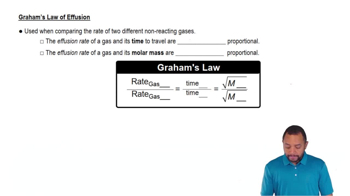
Graham's Law states that the rate of effusion (or diffusion) of a gas is inversely proportional to the square root of its molar mass. This means that lighter gases will diffuse faster than heavier gases. The relationship can be expressed mathematically as (Rate1/Rate2) = √(Molar Mass2/Molar Mass1), allowing for the comparison of diffusion rates between two gases.
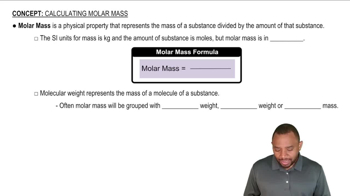
Molar mass is the mass of one mole of a substance, typically expressed in grams per mole (g/mol). It is calculated by summing the atomic masses of all atoms in a molecule. Understanding molar mass is crucial for determining the identity of a gas based on its diffusion rate, as it directly influences how quickly a gas can move through a medium.
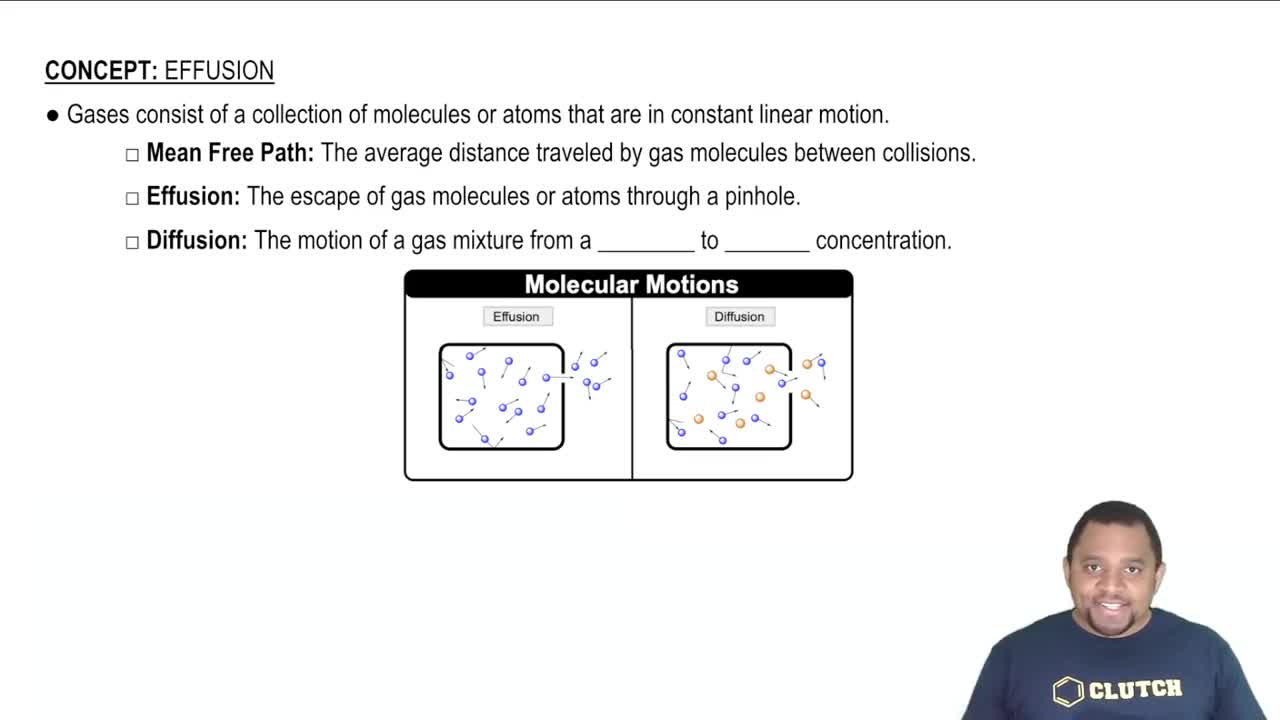
Diffusion is the process by which molecules spread from areas of high concentration to areas of low concentration. In gases, diffusion occurs rapidly due to the high kinetic energy of gas molecules. The rate of diffusion can be affected by factors such as temperature, pressure, and the molecular weight of the gas, making it essential to consider these factors when analyzing gas behavior.


 Guida verificata passo dopo passo
 2:03
2:03