Ch.10 - Gases: Their Properties & Behavior
McMurry - Chemistry 8th Edition
McMurry8th EditionChemistryISBN: 9781292336145Non è quello che usi tu?Cambia libro di testo
Capitolo 10, Problema 107

Which will diffuse through a membrane more rapidly, CO or N2? Assume that the samples contain only the most abundant isotopes of each element, 12C, 16O, and 14N.

Guida verificata passo dopo passo
1
Identify the molecular weights of CO and N2 using the most abundant isotopes: CO is composed of 12C and 16O, and N2 is composed of two 14N atoms.
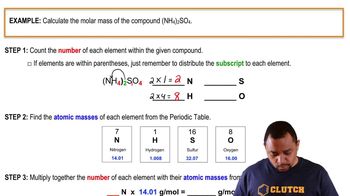
Calculate the molar mass of CO: Add the atomic masses of carbon (12 amu) and oxygen (16 amu) to get the molar mass of CO.
Calculate the molar mass of N2: Add the atomic masses of two nitrogen atoms (14 amu each) to get the molar mass of N2.
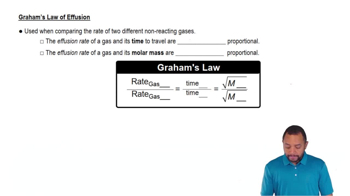
Use Graham's law of effusion to compare the rates of diffusion: According to Graham's law, the rate of diffusion of a gas is inversely proportional to the square root of its molar mass.
Compare the square roots of the molar masses of CO and N2 to determine which gas will diffuse more rapidly.

Risposta video verificata per un problema simile:

Questa soluzione video è stata consigliata dai nostri tutor come utile per risolvere questo problema.
Durata del video:
1m

Concetti chiave

Ecco i concetti essenziali che devi comprendere per rispondere correttamente alla domanda.

Graham's Law of Effusion

Graham's Law states that the rate of effusion (or diffusion) of a gas is inversely proportional to the square root of its molar mass. This means that lighter gases will diffuse more rapidly than heavier gases. In this context, comparing the molar masses of CO and N2 will help determine which gas diffuses faster through the membrane.
Video consigliato:
Percorso guidato
2:03
Graham's Law of Effusion

Molar Mass Calculation

To apply Graham's Law, it is essential to calculate the molar mass of each gas. For CO, the molar mass is the sum of the atomic masses of carbon (12 g/mol) and oxygen (16 g/mol), totaling 28 g/mol. For N2, the molar mass is twice the atomic mass of nitrogen (14 g/mol), resulting in 28 g/mol as well. Understanding these calculations is crucial for comparing diffusion rates.
Video consigliato:
Percorso guidato
03:12
Molar Mass Calculation Example

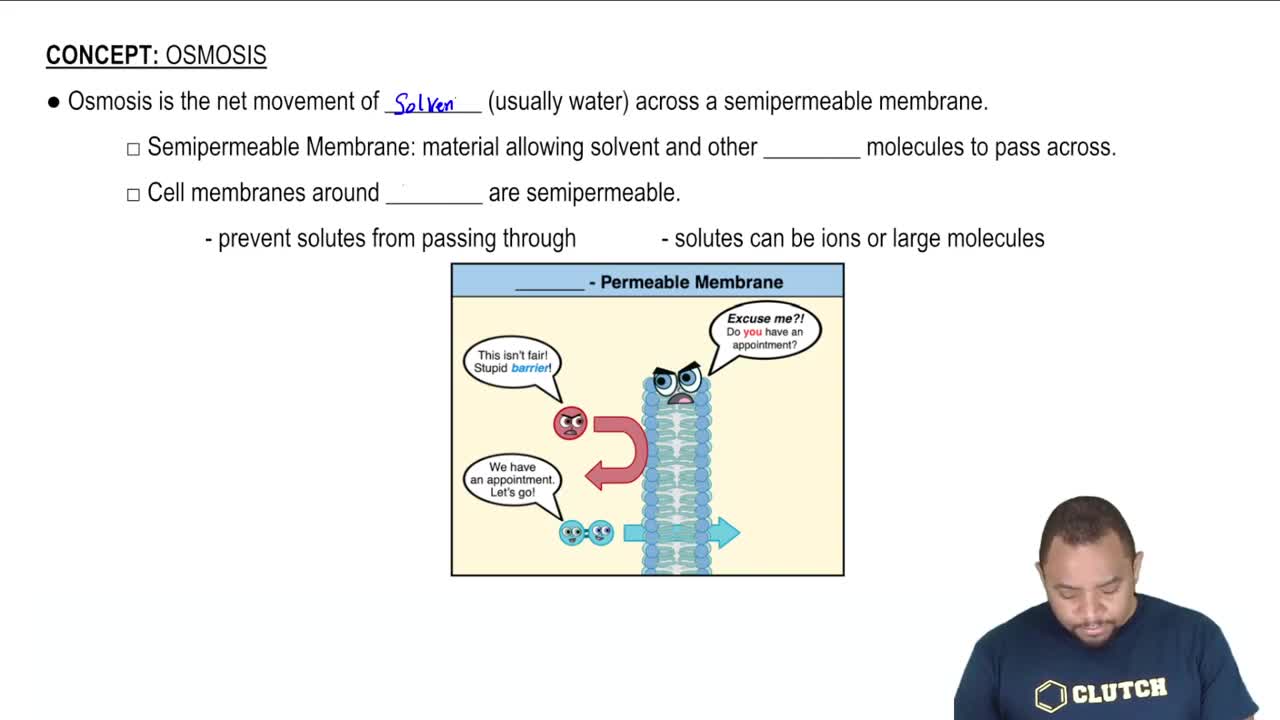
Diffusion and Membrane Permeability

Diffusion is the process by which molecules move from an area of higher concentration to an area of lower concentration. The permeability of a membrane can affect the rate of diffusion, but in this case, since both gases have the same molar mass, the rate of diffusion will primarily depend on their molecular properties and the conditions of the environment.
Video consigliato:
Percorso guidato
01:18
Osmosis and Semipermeable Membranes