
Ch.13 - Solutions & Their Properties
McMurry - Chemistry 8th Edition
McMurry8th EditionChemistryISBN: 9781292336145Non è quello che usi tu?Cambia libro di testo
Capitolo 13, Problema 13

How many kilograms of ethylene glycol (automobile anti- freeze, C2H6O2) dissolved in 3.55 kg of water are needed to lower the freezing point of water in an automobile radiator to - 22.0 °C? The molal freezing point depression constant for water is Kf = 1.86 1°C kg2>mol. (LO 13.13) (a) 0.865 kg (b) 0.0420 kg (c) 9.01 kg (d) 2.61 kg

Guida verificata passo dopo passo
1
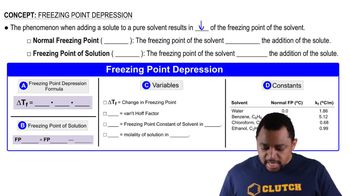
Identify the formula for freezing point depression: \( \Delta T_f = i \cdot K_f \cdot m \), where \( \Delta T_f \) is the change in freezing point, \( i \) is the van't Hoff factor, \( K_f \) is the freezing point depression constant, and \( m \) is the molality of the solution.
Calculate the change in freezing point: \( \Delta T_f = 0 - (-22.0) = 22.0 \) °C.
Assume ethylene glycol does not dissociate in solution, so \( i = 1 \). Rearrange the formula to solve for molality: \( m = \frac{\Delta T_f}{i \cdot K_f} = \frac{22.0}{1 \cdot 1.86} \).
Calculate the molality \( m \) using the values from the previous step.
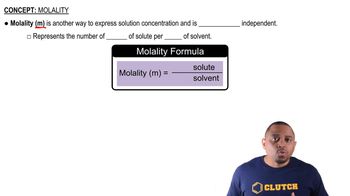
Use the definition of molality: \( m = \frac{\text{moles of solute}}{\text{kg of solvent}} \). Rearrange to find moles of solute: \( \text{moles of solute} = m \cdot 3.55 \). Convert moles of ethylene glycol to kilograms using its molar mass (\( C_2H_6O_2 \) has a molar mass of approximately 62.07 g/mol).

Risposta video verificata per un problema simile:

Questa soluzione video è stata consigliata dai nostri tutor come utile per risolvere questo problema.
Durata del video:
24s

Concetti chiave

Ecco i concetti essenziali che devi comprendere per rispondere correttamente alla domanda.

Freezing Point Depression

Freezing point depression is a colligative property that describes how the freezing point of a solvent decreases when a solute is added. The extent of this depression is directly proportional to the molality of the solute and is quantified by the equation ΔTf = Kf * m, where ΔTf is the change in freezing point, Kf is the freezing point depression constant, and m is the molality of the solution.
Video consigliato:
Percorso guidato
01:59
Freezing Point Depression

Molality

Molality (m) is a measure of the concentration of a solute in a solution, defined as the number of moles of solute per kilogram of solvent. It is crucial for calculating colligative properties like freezing point depression, as it provides a direct relationship between the amount of solute and the effect on the solvent's properties.
Video consigliato:

Molar Mass of Ethylene Glycol

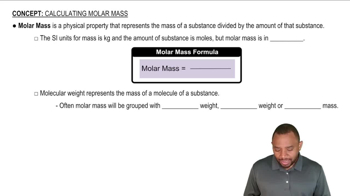
The molar mass of ethylene glycol (C2H6O2) is essential for converting between grams and moles when performing calculations related to freezing point depression. Ethylene glycol has a molar mass of approximately 62.07 g/mol, which allows for the determination of how many moles are present in a given mass, facilitating the calculation of molality in the context of the problem.
Video consigliato:
Percorso guidato
02:11
Molar Mass Concept