
Ch.13 - Solutions & Their Properties
McMurry - Chemistry 8th Edition
McMurry8th EditionChemistryISBN: 9781292336145Non è quello che usi tu?Cambia libro di testo
Capitolo 13, Problema 84

Fish generally need an O2 concentration in water of at least 4 mg/L for survival. What partial pressure of oxygen above the water in atmospheres at 0 °C is needed to obtain this concentration? The solubility of O2 in water at 0 °C and 1 atm partial pressure is 2.21 * 10-3 mol>L.

Guida verificata passo dopo passo
1
First, convert the required oxygen concentration from mg/L to mol/L. To do this, divide the given concentration by the molar mass of oxygen (32 g/mol).
Next, compare the required concentration to the solubility of oxygen at 0 °C and 1 atm. The solubility tells us how many moles of oxygen can be dissolved in 1 L of water under these conditions.
Since the required concentration is higher than the solubility, we need to increase the partial pressure of oxygen above the water. According to Henry's law, the solubility of a gas in a liquid is directly proportional to the partial pressure of the gas above the liquid.
Calculate the ratio of the required concentration to the solubility. This ratio is equal to the ratio of the required partial pressure to 1 atm.
Finally, multiply the ratio by 1 atm to find the required partial pressure of oxygen above the water.

Risposta video verificata per un problema simile:

Questa soluzione video è stata consigliata dai nostri tutor come utile per risolvere questo problema.
Durata del video:
2m

Concetti chiave

Ecco i concetti essenziali che devi comprendere per rispondere correttamente alla domanda.

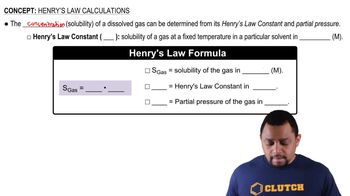
Henry's Law

Henry's Law states that the amount of gas that dissolves in a liquid at a given temperature is directly proportional to the partial pressure of that gas above the liquid. This principle is crucial for understanding how the concentration of oxygen in water relates to its partial pressure in the atmosphere.
Video consigliato:
Percorso guidato
01:40
Henry's Law Calculations

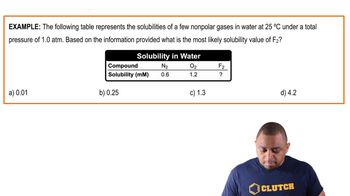
Gas Solubility

Gas solubility refers to the maximum amount of gas that can dissolve in a solvent at a specific temperature and pressure. In this case, the solubility of O2 in water at 0 °C and 1 atm is given as 2.21 * 10^-3 mol/L, which helps determine how much oxygen can be dissolved to meet the survival needs of fish.
Video consigliato:
Percorso guidato
01:44
Gas Solubility Example

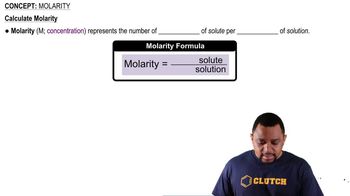
Molar Concentration

Molar concentration, or molarity, is a measure of the concentration of a solute in a solution, expressed in moles per liter (mol/L). To find the required partial pressure of oxygen to achieve a concentration of 4 mg/L, it is essential to convert this mass concentration into molarity using the molar mass of oxygen.
Video consigliato:
Percorso guidato
00:53
Molarity Concept