

Ch.13 - Solutions & Their Properties
McMurry - Chemistry 8th Edition
McMurry8th EditionChemistryISBN: 9781292336145Non è quello che usi tu?Cambia libro di testo
Capitolo 13, Problema 83

Hydrogen sulfide, H₂S, is a toxic gas responsible for the odor of rotten eggs. The solubility of H₂S in water at STP is 0.195 M. What is the Henry’s law constant of H₂S at 0 °C? What is the solubility of H₂S in water at 0 °C and a partial pressure of 25.5 mm Hg?

Guida verificata passo dopo passo
1
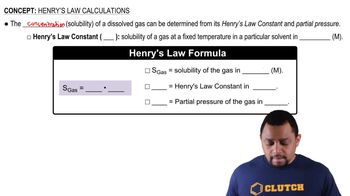
Step 1: Understand Henry's Law, which states that the solubility of a gas in a liquid is directly proportional to the partial pressure of the gas above the liquid. The formula is given by S = k_H * P, where S is the solubility, k_H is the Henry's law constant, and P is the partial pressure of the gas.
Step 2: To find the Henry's law constant (k_H) for H₂S at 0 °C, use the given solubility at STP (0.195 M) and the standard pressure at STP (1 atm or 760 mm Hg). Rearrange the formula to solve for k_H: k_H = S / P.
Step 3: Convert the pressure from mm Hg to atm if necessary, using the conversion factor 1 atm = 760 mm Hg. This will ensure consistency in units when calculating k_H.
Step 4: Calculate the solubility of H₂S at 0 °C and a partial pressure of 25.5 mm Hg using the Henry's law constant found in Step 2. Use the formula S = k_H * P, substituting the new pressure value.
Step 5: Convert the pressure of 25.5 mm Hg to atm if needed, and use this value in the formula to find the new solubility of H₂S in water at the given conditions.

Concetti chiave

Ecco i concetti essenziali che devi comprendere per rispondere correttamente alla domanda.

Henry's Law

Henry's Law states that the amount of gas that dissolves in a liquid at a given temperature is directly proportional to the partial pressure of that gas above the liquid. This relationship can be expressed mathematically as C = kH * P, where C is the concentration of the gas in the liquid, kH is the Henry's law constant, and P is the partial pressure of the gas.
Video consigliato:
Percorso guidato
01:40
Henry's Law Calculations

Solubility

Solubility refers to the maximum amount of a substance that can dissolve in a solvent at a specific temperature and pressure. For gases, solubility is influenced by factors such as temperature and pressure, with higher pressures generally increasing solubility. In the case of H₂S, its solubility in water can change with temperature and the partial pressure of the gas.
Video consigliato:
Percorso guidato
00:28
Solubility Rules

Standard Temperature and Pressure (STP)

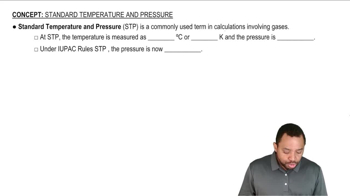
Standard Temperature and Pressure (STP) is a reference point used in chemistry, defined as 0 °C (273.15 K) and 1 atm pressure. At STP, the behavior of gases can be predicted using the ideal gas law, and it serves as a baseline for comparing the solubility and other properties of gases in different conditions. Understanding STP is crucial for calculating changes in solubility and gas behavior.
Video consigliato:
Percorso guidato
01:08
Standard Temperature and Pressure